Linked for life: the importance of sustaining stream-riparian connections
Our recent research focused on how the results of human actions like livestock grazing in riparian zones and invasion of nonnative trout in streams disrupt flows of invertebrates between streams and riparian forests and grasslands. These invertebrates are key food resources for predators in both ecosystems, including birds, bats, lizards, and spiders in riparian zones, and fish in streams (Baxter et al. 2005, Fausch et al. 2010, Marcarelli et al. 2020; see Publications). For example, unrestricted cattle grazing in riparian zones of Colorado and Wyoming rangeland streams reduced in-fall of terrestrial invertebrates that feed trout by about 45-80% compared to more progressive grazing systems, and trout biomass was lower by a third to half (Saunders and Fausch 2007, 2012, 2018). Likewise, invasion of nonnative brook trout in Colorado and Idaho streams reduced emergence of adult aquatic insects by a third to half compared to emergence from streams with native cutthroat trout, which we projected would reduce riparian spiders (a surrogate riparian predator) by 6-20% (Benjamin et al. 2011, 2013).
Science Advisory Boards
I currently serve on four science advisory boards that advise agencies on management and conservation of streams, rivers, and their biota.
- The Independent Scientific Review Panel (ISRP) serves the Northwest Power and Conservation Council by providing reviews of research and management projects aimed at fish and wildlife restoration.
- The Scientific Advisory Board of the Trinity River Restoration Program reviews research and management projects aimed at restoration of salmon and steelhead in the Trinity River, California.
- The Salmonid Specialist Group of the International Union for the Conservation of Nature (IUCN) provides analysis and advice on conserving threatened and endangered salmon, taimen, trout, whitefish, and grayling worldwide.
- The Advisory Council of the Fisheries Conservation Foundation, which promotes science-based conservation of aquatic resources in both freshwater and marine environments throughout the world.
Communicating research to public audiences
Streams and rivers and their biota have declined at an alarming rate in the last 50 years, both in terms of water quality and quantity and the fish and other organisms that inhabit them. However, these ecosystems also hold important values for humans, beyond merely water to drink and fish to catch and eat. In two books, For the Love of Rivers: A Scientist’s Journey (2015. winner of the 2016 Sigurd Olson Nature Writing Award) and A Reverence for Rivers: Imagining an Ethic for Running Waters (2025), I use stories to draw a public audience into the world of stream ecologists, show them the beauty and wonder of rivers and streams, and present a philosophy for why these ecosystems are essential for human well-being. A series of short book-trailer videos, and reviews and blog posts are available at www.riverethic.com
Outreach: RiverWebs documentary film
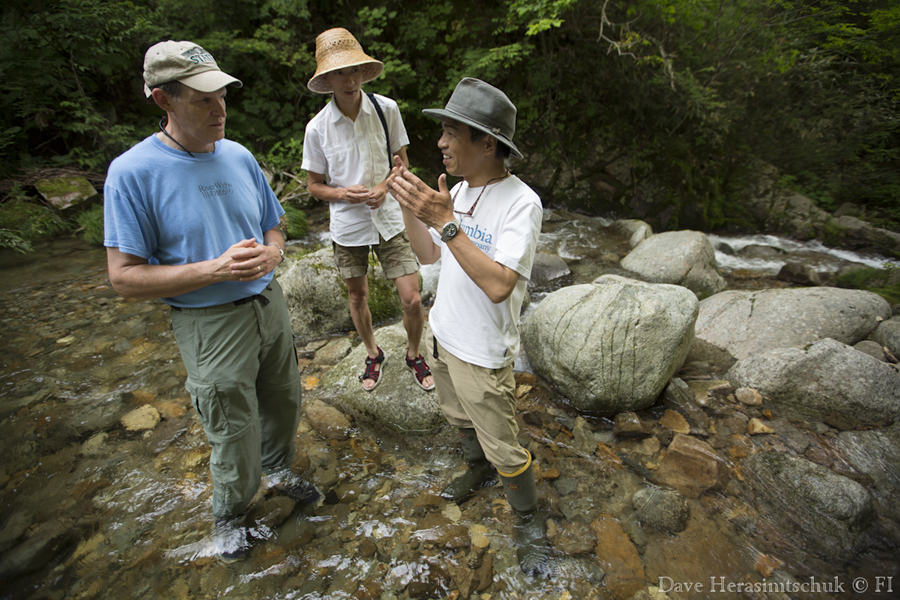
RiverWebs is a feature-length documentary, created by Producer and Director Jeremy Monroe of Freshwaters Illustrated to illustrate the excitement and passion of stream ecologists who work to understand the tangled web of connections between streams and their riparian ecosystems. The film draws viewers into the life and research of Dr. Shigeru Nakano of Kyoto and Hokkaido universities, Japan, who pioneered new ways of thinking about and studying these stream-forest connections. Nakano and I collaborated on research from 1990 until his tragic death in 2000, during which we developed a strong friendship and helped foster linkages between stream ecologists in North America and Japan. The film has been broadcast to more than 100 million homes on PBS, has been shown at the largest environmental film festivals in the U.S. and Canada, and has won awards at a variety of film festivals. In addition to the 57-minute documentary, three shorter educational versions suitable for classroom use are available from Freshwaters Illustrated.