CARRYING CAPACITY AND STOCKING RATE
CENTRAL ORGANIZING IDEA: The number and kinds of organisms that a system will support is complex. It is often couched in the context of issues like, biodiversity, large mammal populations and human populations. The issue is not just numbers, but equitability among secondary producers, sustainability of the use or values, and remediation of historical impact..
Objectives [numbers in brackets cross-reference with goals]
[1,2,3,4,7]Objective 1. Introduce students to carrying capacity models. Discuss subsistence risk strategies vs utilitarian optimization strategies.
[3,4,5,6,7]Objective 2. Give students the opportunity to calculate an estimated stocking rate for large mammals.
Suggest: Chapter 11, 12 and 13, Heady and Child
Chapter 8 in Holechek
Teaching points:
Global: Carrying capacity is an ecological issue; stocking rate is a risk issue. The risk may be environmental or economical.
1. Carrying capacity is a complex issue. It is the number and mix of creatures that can survive and complete life cycles in a given area. The scene will be very dynamic. Populations ebb and flow; individuals come and go. Some animals co-exist as long as resources are not limiting; both intra- and inter-specific competition for resources may become severe.
2. Stocking rate is the number of animals present on an area for a specified period of time. Stocking rate is an expression of animal demand when expressed as AUM/Area or an expression of supply when expressed as Acres/AUM. Stocking rate is directly related to the risk of not meeting ecological or financial goals. Demand of one kind of animal directly impinges on the risk of other animals not meeting needs to complete components of life processes.
3. Secondary productivity is a function of amount and distribution of primary producers.
4. Think of systems as some degree of open; not some degree of closed. Carrying capacity then becomes a question of how resources occur in relation to the life histories and mix of organisms vs the variation in resources at different hierarchal levels of organization. Variety is the key to managing the nutritional environment. Animals respond to variation by moving among patches to find plants and tissue that contain nutrients to complete life cycles. Plants renew nutrients in an asynchronous pattern, because of differences in growing environment.
5. Kind and scale of disturbances (or lack of disturbances) are critical to maintaining diversity of flora and fauna. Disturbance is a patch generator that promotes nutritional variety at both patch and landscape levels of organization.
6. Equilibrium vs non-equilibrium systems.
– when ppt comes during the growing season and enough received (e.g., >350 mm) systems tend toward equilibrium systems. That is, there tends to be more negative feedbacks in the system that dampen the impact of pulsing environmental events.
– when ppt comes during the non-growing season, carrying capacity is less certain and more variable. Pulsing events become important.
– when ppt is erratic and low, regardless of when it is received, carrying capacity is irrelevant; animals adaptability and risk strategies become important. Life histories and pulsing events (e.g., seed production and plant establishment) are critical. Many cycles are asynchronous. Opportunities are erratic and infrequent.
7. In this day and age, the question of what kind and how many animals occupy an area is not biological; it is largely political.
8. By design or default, stocking is strategically used to provide optimum amounts of goods and services or manage risk. The approach to stocking is very different in each case.
– In the case of risk management (e.g., subsistence systems) one maintains a herd composition to be able to provide nutrition, clothes and shelter, while maintaining the ability to deal with the uncertainty of climate and weather (e.g., extended drought).
– In the case of optimizing goods and services, one is concerned about the risk of not maximizing some measure of utility, e.g., dollars.
9. Planning is often supply driven; management is always demand driven. In other words, it is not terribly important which stocking rate we initially choose. What is important is whether the system is responding as anticipated, including both the plants and animals.
Calculation of stocking rate:
First some terms:
Animal Unit Month (AUM). The AUM is both a unit of demand and supply. It is defined in many ways. An AUM is the amount of dry matter a 1000 lb animal, at maintenance, will consume over some time-step, in this case a month (30 days). Heady and Child define an AUM, after the Society for Range Management, as 12 kg/d (26 lb/d dry matter or 780 lb dry matter per month.Animal Unit Equivalent (AUE). An animal unit equivalent is the amount one animal eats in relation to the standard AUM demand unit. Sometimes this ratio is based a linear relationship between weight; sometime it is the relationships based on BW0.75. Personally, I prefer the former; I find little evidence to support the latter. Besides, estimates of either demand or supply are just that- estimates. Consider the normal Coefficient of Variation of intake among animals of the same weight and physiological state is about 30%; then consider the variability in the way animals interact with their environment. We sure aren’t going to worry about decimal points.
Animal Units (AU). Simply number of individuals, often considered by kind, size, age, reproductive status, etc
From the demand side:AUM = (AU)(AUE)(M). If a herd/flock/whatever is made up of several age
classes, sizes or reproductive status, each is considered
separately then summed to give a total AUM demand.From the supply side:
AUM = [(forage production) x (area) x (allowable use*)/(standard animal demand,
per mo) std demand mo = 780 lb* Note I use the term Harvest Efficiency (HE). Others (see Holechek et al) sometimes use the terms utilization and allowable use interchangeably . I use HE because the term utilization can be used to refer to either (1) the difference in standing crop inside vs outside a caged area {includes all material that disappeared; not just that which was eaten}, or (2) it could refer to just the amount that would be ingested.But, this number of AUMs assumes all the forage is accessible; most of the time further adjustments are needed for distance from water or degree of slope. The literature suggest empirical adjustments based on observations and anecdotal information. Sometimes entire areas are not available because of natural barriers.
Assume the following reductions:
| FACTOR | REDUCTION | MULTIPLY BY: |
| Water < 1 mi Water 1 – 2 mi Water > 2 mi |
0.0
0.5 1.0 |
1.0
0.5 0.0 |
| Slope 0 to 10 Slope 10 to 20 Slope 20 to 30 Slope 30 to 60 Slope > 60 |
0.00
0.15 0.25 0.60 1.00 |
1.00
0.85 0.75 0.40 0.00 |
TASK: Determine an initial stocking rate for the Butte pasture.
assume harvest efficiency = .30 [note HE normally ranges between .20 and .50; the higher the
quality, the higher the HE; default value is often about .25]
assume animal demand and AUE as follows:
Cows’ mature weight is about 1200 lb. 1000 lb cow at maintenance = 1.0 AUE; therefore, weight multiplier is 1.2 AUE
Assume 1 demand unit is 26 lb/day; 780 lb/mo
Lactation and calf demand, use AUE multipliers as follows:
May = 1.2; Jun = 1.4; Jul = 1.4; Aug = 1.3; Sep = 1.1; Oct = 1.1; Nov = 1.1
RELATIONSHIP BETWEEN STOCKING RATE, ANIMAL PERFORMANCE, RISK AND ECONOMICS
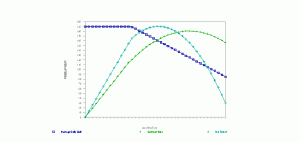
See Heady and Child Figure 11-2. Assumes the system comes to some near equilibrium over time. Note Figure 11-2 assumes a cubic vs quadratic model. Quadratic (above) makes just as much sense and much easier to understand. [Note: sometimes you see this figure and the independent axis (X axis) is acres per AUM vs AUM per acre. The lines look very different]
Stocking decisions are a response to (1) the biological relationship between the animal and the resource, (2) variable costs and (3) selling price. Optimum economic stocking rate depends on ratio of variable cost to selling price. The rule is that maximum net return occurs at a stocking rate between one that allows greatest output per individual vs greatest output per area. To maximize net return one would stock at a lower level when variable costs increase; one would be motivated to increase stocking rate when prices increase.
Optimal stocking rate is independent of fixed costs; fixed costs only affects profitability; not stocking decisions.
Objective 2. Develop a scenario where grazing management is essential to sustainability. This scenario would help students evaluate/anticipate response of a system to grazing methodologies.
Skill 2. Calculate an estimated stocking rate in the Butte Pasture, Meadow Springs Ranch, north of Fort Collins. Create a matrix to help estimate area in each unit/subunit. Base available food on palatable species.
|
Slope 0 to 10
|
Slope 10 to 20
|
||||
| Range Site |
Location
|
Water <1mi
|
Water >1mi
|
Water <1mi
|
Water >1mi
|
| LOAMY PLAINS |
A
|
180
|
|||
|
B
|
40
|
||||
|
C
|
110
|
||||
|
D
|
460
|
130
|
|||
|
E
|
430
|
||||
|
F
|
515
|
29
|
|||
|
G
|
25
|
||||
| SHALLOW SILTSTONE |
A
|
70
|
|||
| LOAMY FOOTHILL |
A
|
490
|
|||
| CLAYEY PLAINS |
A
|
36
|
|||
|
B
|
63
|
65
|
|||
| CLAYEY FOOTHILL |
A
|
51
|
|||
| GRAVELLY FOOTHILL |
A
|
36
|
11
|
||
|
B
|
17
|
11
|
|||
| SHALEY PLAINS |
A
|
390
|
|||
|
B
|
36
|
||||
|
C
|
8
|
||||
| SANDY PLAINS |
A
|
150
|
|||
|
B
|
125
|
110
|
|||
|
C
|
60
|
150
|
|||
| OVERFLOW |
A
|
250
|
|||
|
B
|
46
|
||||
| ROCK OUTCROP |
A
|
120
|
|||
RS300
Takehome Name on back of last
page please
Given: A 10,000 acre rangeland in the sandhills of Nebraska. 2000 Acres is grazed by 265 yearling steers (AUE = .75) for about 4 months, 7000 acres is grazed by 275 cows and calves (AUE = 1.45) for 5 months and 275 cows alone (AUE = 1) for 2 months, 1000 acres is hayed and produces 1.5 tons per acre. One ton of hay is equivalent to 2.5 AUMs.
What is the average stocking rate on the 9,000 acre, expressed as AUM/Acre? The key formula is AUM = (AU)(AUE)(T)
Answer _____
How many AUMs of forage does this ranch produce in one year.
Answer ______
Given: A stocking rate of .20 AUM/Acre; a grazing season of 5.0 months; the area is 40000 acres.
What is the stocking rate expressed as Acre/AUM?
Answer ______
How many cows and calves (AUE = 1.2) could be grazed on the area? Key formula is: [(AU)(AUE)(T)] ÷ ACRES = AUM/ACRE
Answer ______
How long could the same number of 1300 lb cows and their calves be grazed on the same area (AUE = 1.66)? Key formula is: [(AU)(AUE)(T)] ÷ ACRES = AUM/ACRE
Answer ______
If all the cows and calves were removed, how many steers (AUE = .70) could be grazed on this area for the same 4 mo season? Key formula is: [(AU)(AUE)(T)] ÷ ACRES = AUM/ACRE
Answer ______
Given:A rangeland is 9,000 acres in size. The stocking rate is 24 acres/AUY (AUE = 1.0). The area is grazed for 180 days.
How many animals graze the area? Note: this scenario has lots of apples and oranges; i.e., years/days/months. Key formula is: ACRES ÷ [(AU)(AUE)(T)] = ACRES/AUM
Answer ______
Given: An elk was found to consume about 400 lb dry matter/mo.
What is the AUE compared to a standard demand unit? Key idea is AUE is a unitless ratio, i.e., units in numerator must be the same as units in the denominator.
Answer ______
The elk above consumed 3% of body weight a day. How much did it weigh? Key is to first determine how much they eat a day.
Answer ______
Given:A herd of 100 elk, including 42 females (520 lb), 18 adult males (740), 12 yearling males (340 lb), and 20 yearling females (320 lb). [note this is a separate problem; do not use the 3% of body weight above].
>What is an estimated demand of this herd for 1 month, pounds? Answer has to be in pounds. First key idea is AUE is a unitless ratio, i.e., units in numerator must be the same as units in the denominator [note, this calculation has a different basis than the one above]. Second key is that a standard demand unit is 26 lb dry matter per day. Calculate demand of each age class and add ’em up.
Answer ______
What is the estimated average AUM demand of this herd? Key is relationship between an AUM and pounds of forage.
Answer ______