CENTRAL ORGANIZING QUESTION/IDEA: Vegetation on any range site organizes itself in a way that over time tends to converge toward a recognizable, repeatable mix of plants. Initial conditions determine the trajectory of change. But, rangeland vegetation is dynamic. It can exist in many different states. Succession is a process that involves species replacement and changes in species equity over time.
The following teaching points illustrate both a Clementsian model of nudation, migration, ecesis, competition, reaction and stabilization and state and transition. The Clementsian model supposes a system has a single persistent state in the absence of grazing. The community develops to some penultimate state called climax in the absence of large grazers. The model presumes that grazing and drought have similar effects on plant communities and that the undesirable effects of one can be offset by the other; i.e., overgrazed or drought-damaged range can recover by resting or reducing stocking rates in a good-weather year. This model has served us well in numerous environments from semi-arid to sub-humid. It works best under conditions where the bulk of precipitation is received during the growing season. Assumptions related to the interchangability of grazing and drought are not appropriate in many systems. Some transitions may or may not be reversible in arid to very arid systems.
An “alternate” view is the state and transition model of vegetation change. Sometimes this is referred to as a non-equilibrium model. This approach assumes that for a single piece of rangeland there exists a set of discrete and relatively stable states or communities of vegetation. A discrete set of transitions between states also exists. Transitions between states, that is, the change from one relatively stable community to another, is triggered by large changes in weather (such as drought or unusually wet cycles) intense grazing pressure, fire or combinations of ecological factors. Some transitions are readily reversible; some are reversible over time scales meaningful to management; some are not reversible for all practical purposes. I want you to be aware of other models. In the beginning of this paragraph, I used the word alternate in quotes. More often than not, the only differences are among words and application.
Changes occur on multiple time- and space-scales (Bartolome 1989).
very short – daily, weekly
intra-annual
inter-annual
successional
immigrations
evolution
climatic change
An example of time and space variations is given by Heady and Child (1994) from Sharp et al. (1990). Forty years of change in a shadscale stand in Idaho. Rangelands 12:313-328. See page 134.
To our knowledge there is no best model. Our intent is to give you experience with one or two models by developing applications to the real world. Scientists continue to debate the merits of different models of system change. We only have limited agreement on what constitutes rangeland health.
GENERAL:
The objective of this exercise is to prepare students for the unit on succession as one of the organizing ideas needed to manage rangeland ecosystems.
Specific objectives. [numbers in brackets cross-reference with goals].
[2,4,6]Objective 1 and 2. Introduce students to the idea that plant associations are dynamic. Provide historic models of succession and integrate with current models.
Method. We will use a lecture format to introduce students to different ways to explain variation in species composition among similar sites. The lecture will introduce and define ideas like primary and secondary succession, climax, stability, resilience, competition.
[2,3,4,5,6]Objective 3, 4 and 5. Help students explore how and why plant composition might change over time.
Method. Introduce scenarios that (1) ask students to explain why the situation exists as is, or (2) ask students to develop method(s) to engineer a plant community toward a desired future condition.
Students will work in groups. We will ask the students to complete given tasks and then provide them with feedback based on science and experiential models. We will use in-class writing exercises to stimulate discussion and give an opportunity for instructors to share information and clarify concepts.
We will give students in-class quizzes and take-home model tests to reinforce the ideas and facts we think are important.
[3,4,5,6]Objective 5 and 6. Give students a model that successfully manage for an emerging property like diversity (if that’s possible!!). Help students understand that diversity is scale dependent.
Method. Present and discuss case studies where designed disturbance, colonization and vegetation modifiers have been used to create community and landscape diversity under a given set of circumstances, e.g., to meet the needs of a TES species like the swift fox. For example, the swift fox has a home range of about 2 miles. Dan Uresk says it requires both eearly and late seral vegetation. Its food source is prairie dogs, small vertebrates (mice, gophers, etc) and invertebrates like grasshoppers and crickets. It likes to den in areas with tall vegetation with the den elevated slightly above the surrounding terrain, but may not always be necessary. Management for livestock production often creates landscapes with uniform mid-seral vegetation.
We will use the same feedback methods as in Objective 3, 4 and 5 above.
ASSIGN: Chapter 6 – 10
REFER back to INTRODUCTION SYLLABUS: Comparison of ecosystem attributes of early and later seral communities by Odum 1969. Also, Odum’s ecosystem stressors (BioScience 1985).
TEACHING POINTS FOR TOPIC OF SUCCESSION IN RS300
Developed by Rittenhouse and Redente
1. Plant communities change as they mature. These changes can involve species replacement, shifts
in population structure, changes in the availability of resources (e.g., light, space nutrients and
water), and changes in the functional aspects of a system (e.g., productivity, nutrient cycling
and plant/microbe interactions).
2. The trajectory of succession is highly dependent on initial conditions. Succession results from
variation in the ability of organisms to colonize disturbed habitats and from changes in the
environment following the establishment of new species. These environmental changes include
such things as nutrient availability, water availability, space and light.
3. Early seral species sometimes modify the environment (e.g., capturing resources, adding
organic matter to the soil, and shading) so as to allow later-stage species to establish.
Conversely, the establishment of some species may inhibit the entrance of others into the sere
either through competition for limited resources or by direct interference.
4. Succession continues until the addition of new species to the sere and the exclusion of
established species no longer change the environment of the developing community.
5. Herbivory and/or fire can modify a seral community. Most herbivores graze selectively,
suppressing favored species of plants and enhancing competitors that are less desirable as
food. Timing and intensity of fire will also influence species composition as different species
have different tolerances and adaptations to fire.
6. In general, communities become more diverse and complex as succession progresses, but
intermediate stages of succession may be more diverse because they contain elements of early
and late seral stages. Further, the very existence of some plants (and animals) requires both low
and late seral habitats at some position in the landscape.
7. Open systems maintain the capacity to maintain a pseudo-steady state; they possess the
capacity for self-regulation. Self regulation in environmental systems is effected by
negative-feedback mechanisms. They are able to damp-down change.
8. Directional change is also regulated by positive feedback mechanisms. They do not stabilize the
system but have a cumulative effect and reinforce direction of change. This gives us the
opportunity to regulate the trajectory. We would like to maintain organization while the system
transitions to a new state. Trajectories that progressively destroy organization of the system
leads to retrogression and sometimes irreversible change in state.
Comments and notes from Ed Redente
WHAT IS SUCCESSION?
1. SUCCESSION IS ONE OF THE OLDEST, MOST BASIC, AND AT THE SAME
TIME, MOST CONFOUNDED ECOLOGICAL CONCEPTS WE HAVE.
2. SUCCESSION WAS FIRST DESCRIBED BY THEOPHRASTUS IN 300 BC AS HE
OBSERVED VEGETATION CHANGE OVER TIME ON A SMALL PLOT OF LAND.
3. SUCCESSION WAS FORMALIZED INTO AN ECOLOGICAL THEORY IN THE
EARLY 1900S. FREDERICK CLEMENTS WAS A MAJOR PLAYER IN THE
DEVELOPMENT OF THE THEORY.
4. SUCCESSION IS THE BIOLOGICAL RECOVERY OF A PARTICULAR AREA
FOLLOWING DISTURBANCE.
5. SUCCESSION IS A PROCESS OF CHANGE THAT INVOLVES SPECIES
REPLACEMENT, SHIFTS IN POPULATION STRUCTURE, AND CHANGES IN
AVAILABILITY OF RESOURCES (E.G. SOIL NUTRIENTS).
6. PRIMARY SUCCESSION IS THE SUCCESSION THAT OCCURS ON SITES THAT
HAVE NOT PREVIOUSLY SUPPORTED VEGETATION (E.G. VOLCANIC LAVA,
SAND DUNE).
7. SECONDARY SUCCESSION IS THE SUCCESSION THAT OCCURS ON SITES
THAT HAVE PREVIOUSLY SUPPORTED VEGETATION BUT HAVE BEEN
DISTURBED IN SOME WAY.
8. AN IMPORTANT CONCEPT WITHIN SUCCESSION IS CLIMAX. WHERE DOES
SUCCESSION END? IS THERE AN ULTIMATE POINT WHERE THE SYSTEM
REACHES AN EQUILIBRIUM OR STABILITY, AND CHANGE NO LONGER TAKES
PLACE? SOME PEOPLE THINK SO, MANY DO NOT. THE ENVIRONMENT THAT
WE LIVE IN IS CONSTANTLY CHANGING AND WHAT MAY BE CONSIDERED A
CLIMAX TODAY MAY NOT BE A CLIMAX 500 OR A THOUSAND YEARS FROM
NOW. IF YOU USE THE TERM CLIMAX, CAREFULLY DEFINE WHAT YOU
MEAN. I LIKE “LATE SERAL”.
CLEMENTSIAN MODEL OF SUCCESSION
More Redente
CLEMENTS DEVELOPED SIX BASIC PROCESS OF SUCCESSION THAT HAVE BEEN LARGELY IGNORED BY CONTEMPORARY ECOLOGISTS. MOST SCIENTISTS LIKE TO SHOOT HOLES IN CLEMENTS’S WORK AND THEN GO ON AND DEVELOP THEIR OWN HYPOTHESES. HOWEVER, MOST PEOPLE ONLY REINVENT THE WHEEL AND NEVER MAKE A NEW OR IMPORTANT CONTRIBUTION TO OUR UNDERSTANDING OF THIS CONCEPT.
THE SIX PROCESSES ARE:
1. NUDATION
2. MIGRATION
3. ECESIS
4. COMPETITION
5. REACTION
6. STABILIZATION
ALL SUCCESSIONS THAT I AM AWARE OF, WHETHER IT BE IN THE TROPICAL RAIN FOREST, IN AN ALPINE ENVIRONMENT, A HOT DESERT, A DECIDUOUS FOREST IN MICHIGAN, OR A CONIFEROUS FOREST IN IDAHO INVOLVE THESE 6 PROCESSES. THEY MAY OPERATE AT DIFFERENT LEVELS OF IMPORTANCE BUT THEY ALL OPERATE. FOR EXAMPLE, REACTION IS MORE IMPORTANT AND IS MORE INFLUENTIAL IN HUMID REGIONS THAN IN ARID REGIONS.
OTHER MODELS OF SUCCESSION
THERE ARE MANY MODELS OF SUCCESSION. THE NEXT OVERHEAD SHOWS SOME OF THESE MODELS. THEY DON’T TAKE THE PLACE OF CLEMENTS BECAUSE THESE 6 PROCESSES ARE ALWAYS GOING TO BE OPERATING. THESE OTHER MODELS GIVE EXPLANATIONS ON HOW A PLANT COMMUNITY MOVES OR DOESN’T MOVE FROM ONE SERAL STAGE TO ANOTHER.
1. CLEMENTS
2. RELAY FLORISTICS (EGLER)
3. INITIAL FLORISTICS (EGLER)
4. CHANGING RESOURCE AVAILABILITY (DRURY & NISBET)
5. FACILITATION (CONNELL AND SLAYTER)
6. TOLERANCE (CONNELL AND SLAYTER)
7. INHIBITION (CONNELL AND SLAYTER)
IMPORTANCE OF SOIL NUTRIENTS
IN CONTROLLING SUCCESSION
THERE IS GROWING EVIDENCE THAT ONE OF THE MOST IMPORTANT FACTORS CONTROLLING THE PROCESS OF SUCCESSION IS THE AVAILABILITY OF SOIL NUTRIENTS, AND SPECIFICALLY NITROGEN.
THE AVAILABILITY OF SOIL NUTRIENTS MAY BE MORE IMPORTANT IN CONTROLLING THE RATE OF SUCCESSION THAN THE AVAILABILITY OF WATER.
WHY ARE NUTRIENTS, ESPECIALLY NITROGEN, SO IMPORTANT TO SUCCESSION? FIRST OF ALL, N AVAILABILITY TENDS TO BE LOW IN NATURAL COMMUNITIES AND IS THEREFORE A LIMITING RESOURCE. IN ADDITION, THE ABILITY OF PLANTS TO ESTABLISH, GROW, COMPETE, AND SURVIVE IS LINKED DIRECTLY TO THE AMOUNT OF N THAT IS AVAILABLE. AND FINALLY, THE AMOUNT OF N THAT EXISTS IN THE SYSTEM WILL INFLUENCE HOW QUICKLY SOIL MICROBES CAN DECOMPOSE PLANT MATERIAL AND WHICH IN TURN INFLUENCES HOW QUICKLY N IS CYCLED THROUGH THE SYSTEM.
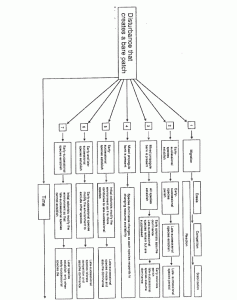
* Below find three components of succession management as described by Lukin:
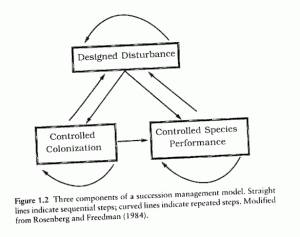
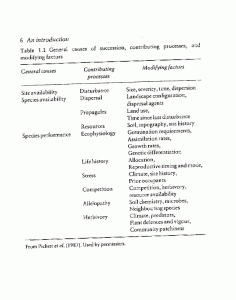
QUESTIONS:
How can we manage succession by changing species performance, i.e., stressing the plant by removing plants or plant parts?
How does fire impact species performance and succession?
How does cutting effect species performance and succession?
How does cabling effect species performance and succession (address incremental growth vs clonal plants)?
How do selective herbicides effect species performance (also herbicides that only kill top-growth, e.g., paraquat)?
How does grazing effect species performance?
How can we manage succession by changing resource availability?
How does disturbance (removal of organisms from a system) change resource availability? What are some ways to naturally enhance available N? What are some natural ways to exhaust available N?
How does changing water level potentially effect species composition?
What change in resources would be required to eliminate or encourage shrubs in the stand?
How can we manage succession by changing propagule availability?
What can be done when propagule banks or seed banks have been removed or destroyed? What is the effect of fire? grazing? cutting?
What can be done to augment propagule supply? What is the effect of fire? grazing? avian species? other foragers?
How does propagule management (revegetation) resemble managed primary succession/secondary succession?
Why are many common pasture grasses, like bromegrass, so aggressive?

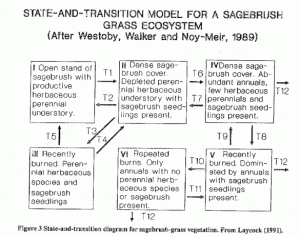
TAKEHOME SKILL: Compare and contrast Clementsian Succession and States and Transitions to explain and predict variation in vegetation dynamics. Re-draw scenario below as a state and transition model.
RS300-An issue of succession
The color maps you have in front of you represent soils and vegetation on the Rocky Mountain Arsenal near Denver, CO. We are particularly interested in Section 23, 1 mi2. The area is now controlled by the US Fish and Wildlife Service and the future use is as a National Wildlife Refuge. The goal eventually is to restore the area to mimic the structure of the shortgrass prairie, including the native plants one would expect these soils to support. Note that section 23 currently supports both pioneer (early seral) annual forbs and grasses and a seeded, alien perennial grass, crested wheatgrass. In addition to cheatgrass, the site contains such species as Russian thistle, kochia, Canada thistle, bindweed, annual sunflower, western ragweed, prickly lettuce, mullein, and yellow sweetclover. In a monoculture, crested wheatgrass forms a steady state condition that resembles a late seral system.
Problem(s):
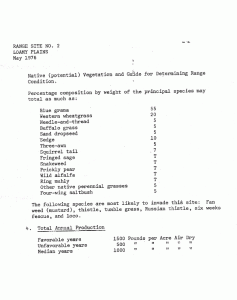
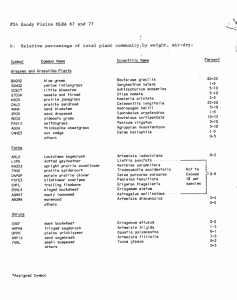
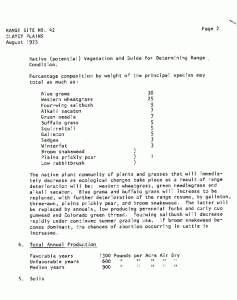
The site is dominated by early seral plants or alien, exotic grasses compared to a mix of natural plants representative of those sites. See pages 16,17 & 18 of syllabus for list of plants normally found on these soils in this management area.
Goal:
The ultimate goal is to restore vegetation in Section 23 of the Arsenal to a native shortgrass prairie.
Objective:
(1) To facilitate colonization of the area with plants indigenous to the shortgrass prairie.
(2) To accelerate the rate of recovery of ecosystem processes.
(3) Restore the ecosystem structure and function of the area to mimic a shortgrass prairie
ecosystem.
Product:
The final product for this exercise is to produce a narrative that describes the restoration and management plan for the site.
Approach:
In order to accomplish the stated goal, there are a number of questions that need to be addressed before a plan can be developed. Let’s simplify the job by breaking it down into tasks.
TASK 1. Define the bio-physical environment in section 23 of the Arsenal, i.e., what it is and what it is not).
TASK 2. What approaches (paradigms) are open as you think about alternative ways to meet the
goal? How would you go about directing succession to meet the goal? Part III of your
textbook has helpful suggestions (pages 301-434).
RS300
Problem #1
Fall 1997 Name __________________________
TITLE DIRECTING SUCCESSION: Restoration of shortgrass prairie structure and function on
Section #23, Rocky Mountain Arsenal.
Page
Title i
Abstract (225 words) 1
Introduction 1
Site description
The physical environment (e.g., soils, climate, toxins) 1
The biotic environment (current flora and fauna) 1
Status of ecosystem processes 1
Goal and Objectives 2
Rationale/Approach 2
Treatments
Weedy forbs area with special consideration of soil properties 2
Cheatgrass/weedy forbs area with special consideration of soil properties 2
Crested Wheatgrass area with special consideration of soil properties 2
Anticipated results
Weedy forbs area 3
Cheatgrass/weedy forb area 3
Crested wheatgrass area 3
Anticipated post-emergence management
Immediate post-emergence 3
Long term 3
Attachments (optional)
1 Description of expected states and management alternatives for different sites, currently
supporting annuals, 0 to 20 years
2 Description of expected states and management alternatives for area currently supporting
crested wheatgrass, 0 to 20 years
Others in my group:
___________________________
___________________________
___________________________
___________________________
___________________________
___________________________
___________________________