CENTRAL ORGANIZING QUESTION/IDEA: What is an ecosystem? All organisms in a bounded area interacting with the physical environment so that a flow of energy leads to a clearly defined trophic structure and mineral cycling. An ecosystem has boundaries. Cannot be defined outside of an issue.
About 80% of students indicate information is redundant with material in
other classes they have taken.
Based on past student surveys, this unit is distributed for information. You are responsible.
Assign Chapter 6, Heady and Child
View video – Ecosystems
Teaching objectives [numbers in brackets cross-reference goals]:
1. [2,5,6]to provide an overview of ecosystems, including terms, processes and
interactions.
2. [1,2,6]To justify the ecosystem as a rationale construct or paradigm for
developing management alternatives and making management decisions;
competing paradigms might include the organism or population or
community.
3. [1]To link biological/ecological systems with human systems
Teaching points:
General: This section is designed to help students understand the importance of the paradigm we use to explain variation in the natural world and the spatial scale we chose to delineate the boundaries of the system we are dealing with.
[2,3] The paradigm we use to approach management does make a difference. The ecosystem is a reasonable construct for explaining the functional relationships in a system. The landscape is a relevant scale for most management decisions. Regional variability can have an effect on global issues like air-born particulates, changes in atmospheric gases, and even climate.
[2,3] Rangeland Ecosystem managers deal with biotic and abiotic stressors and strainers at both the organism and community level in an environment of uncertainty.
[2,3] Rangeland Ecosystem managers manage succession. They worry about levels of soil nutrients and turnover rates; they worry about colonization; they worry about organism performance. Dr. Redente and I will spend 6 to 8 class periods discussing succession.
[1,2,3] Range managers manage aboveground nutrients and their rate of depletion by herbivores. They control the amount of energy/biomass that is stored in different trophic levels and the efficiency of energy transfer. They control the amount of biomass that follows the grazer vs decomposer pathway.
[1,2] Resources are distributed both above and below ground. Talk about the relative amount of biomass above and below ground and implications to management. The amount of total biomass belowground is inversely related to ppt, while the amount of total biomass aboveground is directly related to ppt.
[1,3] Range managers consider the whole system. They worry about linking human and biological systems; i.e., dealing with the complexity of human values and potential resource uses. It would be quite simple to say, “we will manage based on good science.” The implication is that politics will be removed from decision making. The fact is most natural resource issues are political. For example, the biology of a system may determine the suitability of habitat for deer or elk or sage hens or grouse or sheep or feral horses or flycatchers; but, politics will decide the mix.
TASK 1: View video – “Understanding Ecosystems”
Words from the video presentation:
TASK 2: On your own
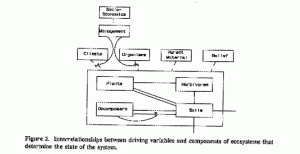
DRIVING VARIABLES ARE HIGHLY INDEPENDENT on reasonable time-scales, e.g., climate, soils, exposure
SYSTEM COMPONENTS ARE VARIABLY INTERDEPENDENT on a wide range of time-scales, e.g., organisms, nutrients
An ecosystem is made up of the biotic and the abiotic
abiotic = mineral soil, water, non-living
biotic = organismal, living
autotrophs – green plants or primary
producers
heterotrophs – secondary producers or
secondary or higher consumers
Herbivores, Omnivores,
Carnivores
decomposers – microbes, fungi
A word about trophic ecology.
– A trophic level is a level of carbon, energy or dry matter storage.
– Some energy is dissipated when transferred to the next trophic level
– So, we say energy flows through the system
– Minerals cycle, hence the CO2 cycle, the P cycle, the S cycle, the N cycle, etc.
TASK 3: more review of ecosystem terminology and comparison to other disciplines; most of this
you can review on your own; tie these to Odum, page 6.
PG = gross productivity
C = consumption
D = decomposition
Rp = respiration in the process of photosynthesis
Net Primary Production = NPP
NPP = PG – Rp
RC = respiration as a result of transfer of energy to the next
storage level
RD = respiration as a result of all decomposition, i.e., both
primary and secondary producers
Net Community Production = NCP
NCP = PG – Rp – RC – RD
TASK 5: Study Figure 6-1, page 76. Review the Nitrogen, Sulfur, Phosphorus and Potassium
cycles. Where is the water cycle?
Some more fundamental definitions that are really important:
ECOSYSTEM BOUNDARY. A system is confined to a definite place in space by the boundary of the system, whether this is natural or arbitrary. It is a defined system of matter plus energy content of that system of matter. The boundary separates it from the rest of the universe. But, energy, carbon or dry matter may be transported across boundaries.
Within the boundary the system has 3 properties:
1. ELEMENTS. Elements of the system are the kinds of substance composing the
system. They be atoms or molecules, or larger bodies of matter like grains of
sand, raindrops, grass plants, rabbits, etc, but each is a unit which exists in both
time and space.
2. ATTRIBUTES. Each element has a set of attributes or states. These elements
and their attributes may be perceived by the senses, or be made perceptable by
measurement or experiment.
3. VALUE. In the case of measurable attributes as number, size pressure, volume,
temperature, color, or age, a numerical value can be assigned by direct or indirect
comparison with a standard.
The most important concept is that the RELATIONSHIP among 2 or more elements or states or 2 or more states which serves to define the states of aggregation of the elements or THE ORGANIZATION OF THE SYSTEM. One of the first questions in the field is, “what organizes this system?”
The state of the system is defined when each of its properties, i.e., elements, attributes and relationships, has a definite value.
KNOW AND UNDERSTAND THE NEXT 2 PARAGRAPHS; these may be the most important ideas presented during this semester.
Systems organize because of negative feedback mechanisms. These are things that damp-down change and become control mechanisms. The process is homeostasis. Positive feedbacks disorganize systems. The process is homeorhesis.
So, it is the interplay of these negative and positive feedbacks that determines the state of the system. Where negative feedbacks predominate, the system tends toward a pseudo steady state. Positive feedback can lead to increase in order and complexity of the system state which results in “developement” of the system; or, positive feedback can progressively destroy organization and lead to a retrogressive and often irreversible change in state.
TASK 6: Read and study syllabus tables on page 6 and 7. Don’t get too up-tight about this now; it is an
important introduction to the unit on why plants grow where they grow and succession. It is mostly
here to get you to thinking about attributes of ecosystems.
Ecosystem Attributes in relation to succession and ecosystem structure and processes. From Odum 1969. [Brackets are my modification.]
Ecosystem Attributes Developmental stages Mature stages
Community energetics
1. Gross production/community respiration (P/R ratio) Greater or less than 1 Approaches 1
2. Gross production/standing crop biomass (P/B ratio) High Low
3. Biomass supported/unit energy flow (B/E ratio) Low High
4. Net community productivity (yield) High Low
5. Food chains Linear, predominately grazing Weblike [Complex], predominately detritus
Community structure
6. Total organic matter Small Large
7. Inorganic nutrients Extrabiotic Intrabiotic
8. Species diversity-variety component Low High
9. Species diversity-equitability component Low High
10. Biochemical diversity Low High
11. Stratification and spatial heterogeneity (pattern diversity) Poorly organized Well-organized
Life history
12. Niche separation Broad Narrow
13. Size of organism Small Large
14. Life cycles Short, simple Long, complex
Nutrient cycling
15. Mineral cycles Open Closed
16. Nutrient exchange rate, between organisms and environment Rapid Slow
17. Role of detritus in nutrient regeneration Unimportant Important
Selection pressure
18. Growth form For rapid growth (“r” selected) For feedback control (“K” selected)
19. Production Quantity Quality
Overall homeostasis
20. Internal symbiosis Undeveloped Developed
21. Nutrient conservation Poor Good
22. Stability (resistance to internal perturbations) Poor good
23. Entropy High Low
24. Information Low High
[25. ]
The following table is from E.P. Odum (1985) Trends expected in stressed ecosystems, BioScience 35:419-422.
Trends Expected in Stressed Ecosystems
Energetics
1. Community respiration increases
2. P/R (production/respiration) becomes unbalanced ( 1)
3. P/B and R/B (maintenance:biomass structure) ratios increase
4. Importance of auxiliary energy increases
5. Exported or unused primary production increases
Nutrient Cycling
6. Nutrient turnover increases
7. Horizonal transport increases and vertical cycling of nutrients decreases
8. Nutrient loss increases (system becomes more leaky)
Community Structure
9. Proportion of r-strategists increases
10. Size of organisms decreases
11. Lifespans of organisms or parts (leaves, for example) decrease
12. Food chains shorten because of reduced energy flow at higher trophic levels
and/or greater sensitivity of predators to stress
13. Species diversity decreases and dominance increases; if original diversity is low,
the reverse may occur; at the ecosystem level, redundancy of parallel processes
theoretically declines.
General System-Level Trends
14. Ecosystem becomes more open (i.e., input and output environments become
more important as internal cycling is reduced).
15. Autogenic successional trends reverse (succession reverts to earlier stages)
16. Efficiency of resource use decreases
17. Parasitism and other negative interactions increases, and mutualism and other
positive interactions decreases
18. Functional properties (such as community metabolism) are more robust
(homeostatic-resistant to stressors) than are species composition and other
structural properties
TASK 6: More thoughts on management challenges. Are organisms important? You bet they are.
Are populations important? You bet they are. Are communities important? You bet
they are. Are landscapes important? You bet they are. Then why do I emphasize the
ecosystem and landscape scales?
Hierarchy of scales and how things are related, e.g., individual to community to landscape to regions to continents to global systems. Hierarchy theory states that organization at a given level is the aggregate of organisms and processes at the next lowest level. And, what happens at any level is constrained by the level above. For example, the grazing pattern I observe on a unit of land is the aggregate of grazing activity within the area, but some areas may not be grazed because they are not accessible.
Resources are distributed on multiple temporal and spatial scales. Rangeland Ecosystem managers often have viewed this heterogeneity as a management challenge, especially as it related to animal distribution and utilization. Management typically strives for uniformity in utilization of nutrients with minimum impact on other components of the system.
– sometimes management for “uniformity” over large spatial scales is appropriate. Note Chapter 13, “Animal
Distribution.”
– sometimes management for “non-uniformity” at multiple or pre-determined scales is appropriate. Note Heady and Child do not have a counterpart to Chapter 13 that might be entitled, “methods of using livestock to create heterogeneous environments on multiple scales.
– Different fauna, on different trophic levels, respond to variability in resources in different ways. Bottom line is how animals respond to that variability in relation to risk, especially during life-cycle bottlenecks, e.g., nesting. Some fauna respond best to heterogeneous environments at both small and large scales; others respond best to uniformity on small scales and heterogeneity at large scales; with all combinations in between.