RS300
UNITEXAM001
09-17-99
Multiple answers are possible
You must mark all questions: grade based on those with “a” designation.
1a. I was browsing a textbook the other day and ran across the statement: “grazers in the serengetti and similar places with high animal densities remove vertually 100% of the above ground net primary production.” (a) sounds reasonable (b) impossible.
2a. Give the Rittenhouse definition of a problem.
Deviation from a standard or mean
3c. Rittenhouse’s primary teaching goal is (a) provide student with an understanding of rangeland ecosystem structure and function (b) discuss the merits of different methods of rangeland restoration (c) help students establish a manner of thinking that serves as a life-long learning model for conservation and management of rangeland values and uses (d) provide experience in evaluation of the science (d) develop a repertoire of generalizations applicable to rangeland management.
4a. Natural resource managers develop strategies to deal with environmental, political, economic and cultural uncertainties (a) yes (b) no
5a. Historically the word rangeland derived from its use, similar to cropland, forestland, wasteland, etc. (a) yes (b) no
6a. One important function of rangelands is a source of municipal and recreational waters. (a) true (b) true
7a. The goal of a public-agency manager should be to transform my value system (a) true (b) false
8a. The goal of a public-agency manager should be to find a way to deal with biological and human diversity (a) true (b) false
9c. The “science” in the College of Natural Sciences is fundamentally different than the “science” in the College of Natural Resources. (a) true (b) false (c) not sure
10a. In order to address a problem, the goal is always to find cause. (a) true (b) false
Sometimes the best we can do within time and resource constraints is find a solution
11a. Livestock grazing is a renewable resource. (a) true (b) false
Livestock grazing is a use
12a. Recreation is a renewable resource. (a) true (b) false
Recreation is a use
13c. As a stakeholders in an issue you represent a set of values. My job as a manager is to convince you to adopt my value and belief set. (a) true (b) false (c) not sure
14a. Give 2 examples of elements of the system; describe the attributes of each.
1. Sand mass per unit volume
2. Prairie sandreed, a grass mass per m2
15a. I have decided to generate wealth from my private land by offering guided hunting. I have made a: (a) strategic decision(b) tactical decision (c) operational decision
16a. I decided to apply the herbicide in the evening vs morning. I have made a: (a) strategic decision (b) tactical decision (c) operational decision
17a. I decided to use a 4-pasture, 3 herd system vs continuous, season long grazing. I have made a: (a) strategic decision (b) tactical decision (c) operational decision
18a. I decided to feed protein supplement 2 times a weeks vs every day. I have made a: (a) strategic decision (b) tactical decision (c) operational decision
19a. I monitored a cheatgrass/sagebrush system in southwest Idaho between 1948 and 1999. The herbaceous layer of the stand was dominated by cheatgrass in 1948 and remains dominated by cheatgrass in 1999. In fact, there is probably less sagebrush now than 1948 and it’s probably lower in stature. I don’t see a problem. Do you? (a) yes. (b) no. (c) no way to know. (d) insufficient information to define the problem.
20a. The problem in 19a above could have been fire frequency. (a) true(b) false
Fire might have been a cause
21a. If a system’s structure is the same now as in the past, you could say there is no problem. (a) yes (b) no.
This tricky. The system may have very different structure now than some time in the past. We don’t know because of no records or lack of institutional memory.
22a. Management is a goal. (a) true (b) false
management is a process
23a. Decision making in natural resources is always open-ended. (a) true (b) false [parenthetically, if systems are open-ended and things are always changing, how
long should you let the system run before intervening in order to maintain a desired trajectory? How do you know when to intervene again?]
24a. In temperate climates shrubs are at an advantage when precipitation occurs at a time when temperatures are favorable for growth. (a) true (b) false
25a. The coincidence of precipitation (400 mm) and temperature suitable for growth is high and soils are very fine sandy loam, which plants are favored? (a) shrubs
(b) grasses
26a. Which has the highest water availability? (a) sandy loam soil (b) clay loam soil
27a. Conifers are generally more drought tolerant than deciduous trees(a) true (b) false
28a. Pan evaporation always exceeds annual precipitation (a) true (b) false
Think about a cold climate with a very short growing season
29a. If coincidence of precipitation and temperature is low and soils are moderately coarse would you expect to find (a) grasses (b) shrubs
30a. You are in tropical temperature zone, the potential evapo-transpiration ratio is32, annual precipitation is between 125 and 250 mm. you are probably looking
at (a) desert (b) desert shrub (c) thorn woodland (d) rain forest
31a. The climate is semi-arid. Precipitation ranges between 200 and 350 mm, with an average of 300 mm. Fifty to 60 % of the precipitation comes in the late fall,
winter and spring. Summers are quite dry. I would never expect to see trees in this area. (a) true (b) false
32a. I’m looking at a record of precipitation. Temperate zone. The annual precipitation is 1125 mm. Precipitation is about 3 to 4 inches per month from January
through August, and about 2.5 to 3 inches per month from September through December. One would expect the dominate vegetation to be (a) grasses
(b) shrubs (c) trees
33a. 1125 mm is how many inches? 44.3 inches
34a. An attribute of vegetation is cover (a) true (b) false
35a. An attribute of vegetation is mass (a) true (b) false
36a. Many rangeland ecosystems historically were converted to cropland ecosystems. These lands can never again be classified as rangelands. (a) true-true
(b) true-false (c) false-true (d) false-false
37c. Is it acceptable to mix politics and science? (a) I think it’s okay; it depends on the situation (b) never (c) not comfortable responding to this question
38c. Is it acceptable to do research designed to solve a specific agricultural production problem? (a) yes (b) never, science should be for the good of all (c) not
comfortable responding to this question
39c. Should all research contribute to science? (a) yes, especially if it is funded from public money (b) no, understanding an empirical relationship
between elements or attributes could be needed to address a specific issue (c) not comfortable responding to this question
40c. I am more motivated to learn about management of rangelands now than when I started this class. (a) strongly agree (b) agree (c) disagree
41c. Which best describes your value/belief system? (a) anthropocentrism (b) eco-centrism (c) techno-centrism (d) theo-centrism (e) econo-centrism
42c. How many generations are you removed from someone in your direct lineage that had to depend on the land for most of their sustenance, i.e., food, fiber and
disposable income?
________ generations [for example, if you depend on the land write 0, if your parents depend on the land for most of their needs write 1, if your
grandparents mostly depended on the land write 2, etc]
43a. Deer are (a) decomposers (b) primary consumers(c) omnivores (d) secondary producers(e) carnivores (f) herbivores
44a. The amount of carbon or energy stored at the 3rd trophic level is about 80 % of that found at the 2st trophic level. (a) true (b) false
45a. Nuked
46a. Digestibility is the percentage of ingested feed absorbed from the gut. (a) true (b) false
47a. The digestion coefficient has no units, i.e., it is a decimal fraction.(a) true (b) false
48a Given a rangeland that produces about 1000 lb of edible forage per acre. The rangeland is a bounded area of 10000 acres. My research team sampled
populations of all the heterotrophs we could find and estimated their weight. My numbers show 5,000,000 pounds of heterotroph biomass on the 10000
acres. (a) probably about right; at least possible. (b) not a chance; go look again.
49a. Rangeland plants have many mechanisms to cope with defoliation (examples of defoliation include fire and herbivory) (a) true
50a. I am at Springfield, located in the far southeast corner of Colorado. Precipitation is about 380 mm. Peak Standing crop in late July (ungrazed) is about (a) 35
lb/acre (b) 300 lb/acre (c) 800 lb/acre (d) 5000 lb/acre
51a Grass cannot grow in areas with less than about 15 inches annual precipitation. (a) true (b) false
52c. The more fundamental conception is…the whole system (in the sense of physics), including not only the organism-complex, but also the whole complex of
physical factors forming what we call the environment…the habitat factors in the widest sense…Our natural human prejudices force us to consider the
organisms…as the most important parts of these systems, but certainly the inorganic “factors” are also parts,…and there is constant interchange of the most
various kinds within each system, not only between the organisms but between the organic and inorganic. These ecosystems, as we call them, are of the most
various kinds and sizes. (a) Rittenhouse et al, 1999 (b) Tansley 1935) (c) Zigler, in press)
RS300
UNITEXAM
10-15-99
I have prepared a supplemental sheet to accompany the test. You have seen it before (well, slightly altered).
1. The 1,981,488 lb of palatable forage represents the peak standing crop of edible forage in this pasture. (a) yes (b) no
2. The FAF (forage acre factor) for the Loamy Plains range site in the Round Butte Pasture is (must include correct units of expression):
640 Ac ÷ 248 AUM = 2.74 Ac/AUM
3. Stay with this same line (Loamy Plains – Round Butte pasture). How many 1000 lb, non-lactating cows could that location support for 6 months?
248 AUM/6 mo = 41
4. Pastures have different carrying capacities because they are different sizes and have different mixes of range sites. Suggest below how many days animals might
stay in each pasture on the first rotation to attain an average 40 rest period
| Pasture | Days stay in each pasture |
| Round Butte | 12 |
| Windmill | 10 |
| Spring Unit | 8 |
| Antelope | 7 |
| Upper Middle Lewis | 6 |
| Lower Middle Lewis | 6 |
5. What is the average stocking rate in the Antelope pasture expressed as AUM per acre?
377 AUM/1062 Ac = .36 AUM/Ac
6. What is the average stocking rate in the Spring Unit pasture expressed as acre per AUM?
992 acres/424 AUM = 2.34 Ac/AUM
7. Which has the highest relative carrying capacity (not absolute)? (a) Antelope pasture? (b) Spring Unit pasture? [the estimated absolute carrying capacity of
the Antelope pasture is 377 AUM; the Spring Unit pasture is 424 AUM]
8. Consider this management area. What is a reasonable range of stocking rates expressed as acres per AUM (late seral conditions)? (a) 0.3 to 0.6 (b) 1.2 to 7
(c) 25 to 45 (d) 14 To 24
9. The AUE in this scenario was 1.5. That means (a) average dry matter demand was 1170 lb/month (b) cows weigh 1500 pounds (c) calves weigh 1500 lb
(d) cows could weigh less than 1000 lb (e) cows could weigh more than 1000 lb (f) cows could weigh more than 1500 lb
10. Refer again to the Meadow Springs scenario. Total AUM in this management unit was 2540. That could represent (a) 1411 cows and calves (AUE = 1.8)
for 1 month (b) 635 cows (AUE =1) for 4 months (c) 282 cows and calves (AUE = 1.5) for 6 months. (d) 55 elephants (AUE = 11.5) for 2 mo
[assuming the habitat was suitable] (e) none of the above
11. Distinctions among range sites include: (a) difference in the kinds of plants that compose a late seral plant community (b) differences in the
proportion of plants that compose a late seral community (c) difference in the total annual yield of late seral plant communities (d) none of the
above
12. Start with an unfenced parcel of land. Your planning team decides the best way to meet a goal related to some value is to graze each area (equal size in this
instance) for 6 days and rest each area 42 days. How many pastures would fit that scenario, on average?
8 pastures = [42 + 6] ÷ 6
13. Write in your own words a definition of harvest efficiency:
HE is consumed or ingested ÷ available
XX.
Given: A rangeland in SW Kansas, a southern mixed grass prairie in an area of about 18 inches of precipitation, produces a peak standing crop of desirable plants for cattle of about 1950 lb per acre. The area is 6 sections or 3,840 acres. Ingestion or consumption per day (per cow) was estimated from the formula [I call this the Rittenhouse quick and dirty method]: [(Fecal output x physiological demand compared to maintenance) divided by the indigestion coefficient; or, {(1200 lb x .0105) x (1.20)}/(1-.60) = 37.8 or 40 lbs forage intake/day.
14. Use the 40 pound/day number. What is the AUE of a cow-calf pair when calf gets most of nutrients from milk? [later on, the AUE would be adjusted because
the cow would give less milk, but the calf would be consuming more forage]
40 lb/day/26 lb/day = 1.54 = AUE
15. So, this area produces about 7,488,000 total lbs of forage. Topography is undulating. The area is well-watered. Most of the plants are palatable (90%). A
harvest efficiency of .25 is reasonable, season-long. Animals are here only 150 days. Give me first-best-estimate of supply, expressed as total AUMs?
2160 AUM
16. How many AU could graze this area for the 150 days?
280 AU [remember this handy formula: AUM = (AU)(AUE)(M)]
2160 AUM = (AU)(1.54)(5 mo)
AU = 280
17. What is the digestibility of this diet?
60 percent
18. Write in your own words a definition of utilization:
Utilization is the amount of forage dry matter that disappeared compared to a caged or season’s growth. When divided by the dry
matter represented by a season’s growth, the expression is percentage utilization.
XX. What are the 3 criteria we used to distinguish among range sites?
19. Kinds of plants that compose a mature plant community
20. Proportion of plants that compose a mature plant community
21. Differences in yield or productivity of a mature plant community
22. Stocking rate has units of:
AUM/Area or Area/AUM
23. Carrying capacity has units of:
Same as 22 above
24. Heady and Child define an AUM, after the Society for Range Management, as 12 kg/d (26 lb/d dry matter) or 780 lb dry matter per month. (a) yes (b) no
25. Give the definition of an AUE:
AUE is a ratio of amount ingested compared to standard demand of 26 lb/day, because of differences in weight
or physiological demand.
26. From the demand side:
AUM = (AU)(AUE)(M). If a herd/flock/whatever is made up of several age
classes, sizes or reproductive status, each
is considered separately then summed to give a total
AUM demand.
From the supply side:
AUM = [(forage production) x (area) x (allowable use or HE)/(standard
animal demand, per mo). [std demand mo = 780 lb]
R = (DG)(P – 1) where R is rest; DG is days graze in each pasture; P is
number of pastures.
Question 26 requires no response
27. That’s enough.
RS300
UNITEXAM003
10-20-99
01. Rhizomes and stolons are often found on the same plant. (a) true (b) false
02. Perennial grass reproduce only by seeds. (a) true (b) false
03. Grasses typically have hollow, jointed stems with leaves on 2 sides of the stem. (a) true (b) false
XX The phytomer is the basic unit of the grass plant.
04. the phytomer is always a short shoot. (a) true (b) false
05. the phytomer has no intercalary or axilary meristems. (a) true(b) false
06. the leaf is a part of the phytomer. (a) true (b) false
07. the sheath and the blade make up the leaf. (a) true (b) false
08. only long shoots have internodes. (a) true (b) false
09. A grass tiller is classified as a long shoot if phytomers elongate.(a) true (b) false
10. A long shoot dies within the same season it is defoliated. (a) true (b) false
11. A grass plant might be made up of hundreds of phytomers.(a) true (b) false
12. Saturday (10-16), I was out near Sterling, CO, with a group of students. The area was fine sand. Needleandthread (yes, it is all one word) was common.
Needleandthread is a C3 grass. A high percentage of the tillers remain short shoots in a given year. For this question, leaves are about 10 cm. A saw where a cow
had eaten about 70% of one plant. Respond to this statement: apical dominance was removed. (a) true (b) false
Most of growing points are near the ground and out of reach of the grazer.
13. Same scenario as 12 above. Respond to this statement: the plant died. (a) true (b) false
14. Same scenario as 12 above. Respond to this statement: most of the tillers will die this season. (a) true (b) false
No, most short shoots will survive till next season, but seldom more than a couple of years.
15. Same scenario as 12 above. Some tillers had become long shoots late last spring. A cow ate most of the long shoot, just before the seed emerged from the boot.
[recall we talked about the boot stage of phenological development; the boot is the leaf-like tissue that surrounds the inflorescence before it emerges]. (a) the tiller
died (b) adjacent tillers died (c) rate of root growth was accelerated
16. A panicle is a branched fibrous root system. (a) true (b) false
17. Root growth typically is reduced or stopped within hours to days of a defoliation event, but is species dependent. (a) true (b) false
18. When the growing point of a grass is grazed, the (a) oldest(b) youngest parts of plant are removed.
19. The (a) oldest (b) youngest leaves and stems are photosynthetically more efficient
20. Boy, did I make mess of things?!? After I went back to my office on Monday, got to thinking about the stress and strain thing. What did I say? I can’t remember.
Two brain cells go south and I’m in trouble. What I meant to say is this, “plant stress is an external factor applied to the plant, i.e., heat, cold, nutrients, drought,
defoliation, etc. No response required.”
21. Plant strain is the response to applied stress, for example, Photosynthesis, growth rate, death rate, seed production, etc. Stress = the test; Strain = the stomach ache.
No response required.
22. Light is often growth-limiting to grasses on semi-arid rangelands. (a) true (b) false
23. The optimal temperature for photosynthesis is highest for: (a) C3 (b) C4
24. Which grass extracts more water at high temperatures? (a) C3 (b) C4
25. When nutrients, like nitrogen, are limiting, individual plant growth rates may be depressed, but the system may be more stable. (a) true (b) false
26. Respiration is often inversely related to photosysthesis, i.e., as Ps goes down, Rs goes up. (a) true (b) false
27. In a temperate climate with distinct growing and dormant seasons, plants are in negative carbon balance for extended periods of time. (a) true (b) false
28. Nuked. Andrea didn’t like this question. I don’t want to renumber.
29. Prairie sandreed is a C4 grass typically found on sandy soils. Plants have large rhizomes. When apical dominance in a grass is removed, because the inflorescence
is mature, a new rhizome begins growth.(a) true (b) false
30. Refer to 29 above. In a temperate climate like Colorado or central Nebraska, new rhizomes probably appear about June 15. (a) true (b) false
31. When apical dominance in a grass is removed by biting, a new tiller is initiated. (a) true (b) false
32. Biting almost always removes apical dominance in a grass at the 4-leaf stage of growth. (a) true (b) false
33. C3 plants usually grow better under warm and dry conditions. (a) true (b) false
34. Plants that exhibit a “U” shaped carbohydrate depletion and replenishment cycle usually die if grazed during the growing season. (a) true (b) false
35. Plants with a “V” shaped CHO depletion and replenishment cycle are least vulnerable to defoliation during the dormant period. (a) true (b) false
36. Which compounds are examples of carbohydrates? (a) sucrose (b) linoleic acid (c) amylose (d) alanine (e) acetic acid
37. Grazing can be heavier if opportunity for regrowth and environmental conditions are conducive to regrowth following grazing. (a) true (b) false
38. Litter buildup in nongrazed areas is beneficial to tillering. (a) true (b) false
39. Litter buildup is detrimental to system stability. (a) true (b) false
40. You want to bio-engineer a plant community north of Fort Collins to another plant composition. One of the plants, buffalograss, is found in much greater abundance
than desired; western wheatgrass in lower abundance. Should I first develop management strategies to deal with (1) buffalograss or (b) western wheatgrass?
41. Once again refer to my experience last Saturday with the students near Sterling, CO. One of the areas we visited had few saltbush or winterfat plants, but only a
few yards away on the other side of the fence, saltbush was common. (a) fences are detrimental to saltbush and winterfat. (b) the area with few to no saltbush
plants may have been historically grazed in the summer. (c) to mange for greater saltbush composition, I should remove the fence. (d) to manage for saltbush
I should remove all grazing on both areas(e) to manage for saltbush I should encourage spread of seed (but how? what is the biology?) and plan to
incorporate rest periods between graze periods. (f) rest periods should be less than 30 days to insure more uniform utilization
42. You have been called to the front of the class to describe the tillering response of a cool-season grass following removal of the apical meristem. For example, you
would defend the argument that the tiller will survive into the next growing season? (a) yes (b) no
43. Situation. You have been invited to give a presentation to the Loveland Garden Club. You are well into your presentation, when someone asks if the buffalograss (a
stoloniferous, C4) in their pasture needs to set seed in order to fill the bare patches. (a) yes (b) no
44. Response of an individual plant to herbivory under natural conditions depends on frequency, intensity and timing of defoliation in relation to phenological
development, associated plants, individual species’ characteristics (morphogenesis) and opportunity to compensate for herbivory (environment). Dr Woodmansee
wants you to elaborate on the grazing response index in his basic ecology class. You volunteer to help him lead the discussion. (a) You tell the class, “intensity of
defoliation is the most important factor determining future growth and production of the plant.” (b) You tell the class, “grasses grazed in the spring will die.” (c) You
tell the class, “if plants have most of the growing season to recover, they will do `just fine’.”(d) you tell the class, “defoliation by bison has less negative
impact on the plant than sheep.”
45. In temperate zones like Colorado (native/natural rangeland), 25 days opportunity to regrow following defoliation in late spring is probably adequate, even if more than
50% of the leaf was removed. (a) almost certainly(b) probably not
46. An understanding of the mechanisms that allow a plant, monocot or dicot, to withstand the effects of defoliation is fundamental to the professional rangeland
manager. (a) yes (b) no
47. Short shoots (graminoids) are represented by phytomers with elongated internodes. (a) true (b) false
48. Plants that exhibit a “U-shaped” carbohydrate depletion/replenishment cycle are vulnerable to herbivory during the active growing period, i.e., they recover more
slowly than if defoliated during a dormant period.(a) true (b) false
49. Root growth typically occurs much earlier in the growing season than top growth. (a) true (b) false
50. The stem is the basic unit of the grass tiller. (a) true (b) false
51. Forbs have solid stems. Many have showy flowers, but not all. Generally have broad leaves. (a) true (b) false
52. C4 compared to C3 grasses generally have more fiber and cell walls are thicker. (a) yes (b) no
53. C4 compared to C3 grasses generally contain less nitrogen (especially tall species at maturity) (a) yes (b) no
54. CHO content of C4 compared to C3 grasses are generally simple sugars. (a) yes (b) no
55. C4 compared to C3 grasses generally have greater tolerance for high temperatures (optimal photosynthesis occurs at higher temperatures) and they draw water at
higher tension (a) yes (b) no
56. Generally, the way you tell a shrub from a tree is shrubs have multiple stems. (a) yes (b) no
57. That’s enough
RS300
UNITEXAM004
11-19-99
1. Plants that occupy areas following drastic disturbance often are opportunistic; they establish and survive under conditions of
excess free nitrogen.(a) true (b) false
2. Organic material that moves through the decomposer vs grazer pathway turns over at a slower rate. More soil N is made
available to growing plants. (a) true-true (b) true-false (c) false-true (d) false-false
3. In late seral stages more energy is transferred through the decomposer than the grazer pathway. (a) true (b) false
4. Disturbance closes mineral cycles. (a) true (b) false
5. Disturbance is a natural and important process in ecosystem dynamics. (a) true (b) false
6. Mineral cycles are said to be closed when biogeochemical cycles are “tightened,” i.e., the system entraps and holds nutrients
for cycling within the system.(a) true (b) false
7. Mature ecosystems exhibit (a) good (b) poor nutrient conservation.
8. Mineral cycles are said to be open when biogeochemical cycles are “leaky,” i.e., nutrients are lost from the system either
through leaching, volatilization, overland flow, etc., or uptake by N-opportunistic plants. (a) true (b) false
9. Nitrogen cycling and uptake in grazed plants is(a) more (b) less than ungrazed plants.
10. An alternate model of vegetation dynamics, the state-and-transition model, allows for more than one possible “steady state”
condition. (a) true (b) false
11. Surface soils (0 to 30 cm) in grazed areas almost always have a (a) higher (b) lower C/N ratio than ungrazed areas
12. Free soil nitrogen is usually (a) higher (b) lower in grazed than ungrazed areas.
13. Colonization is (a) nudation (b) migration (c) ecesis (d) competition (e) reaction
14. Disturbance with organism (vegetation) removal is (a) nudation (b) migration (c) ecesis (d) competition (e) reaction
15. An area (north-central Utah) is dominated by big sagebrush (20% canopy cover). A rich complex of perennial herbaceous
plants is present. (a) This area was probably never grazed in the spring (b) Few changes would be expected in the next
decade if the area is always grazed after seed-ripe of the dominant grasses, i.e., bluebunch wheatgrass and idaho
fescue. (c) Assume a fire. Most of the perennial herbaceous vegetation died. (d) After removal of big sagebrush by fire
and removal of cattle grazing, some cheatgrass could colonize the area and persist for several years.
(e) Perennial herbaceous production would decline following removal of big sagebrush with a spring application of 2 lbs of
2,4-D per acre.
16. Colonization refers to plant recruitment into a gap (an open space) by means of seed or vegetative reproduction. (a) true
(b) false
17. When organisms vie for resources it is called (a) nudation (b) migration (c) ecesis (d) competition (e) reaction
18. Disturbance is a natural and important process in ecosystem dynamics and succession. All ecosystems are continuously
recovering from some kind of disturbance on different spatial and temporal scales. (a) true-true (b) true-false (c) false-true
(d) false-false
19. Fire can be (a) a disturbance. (b) a facilitator of colonization. (c) a vector determining species performance.
20. One of the important effects of disturbance is release of nutrients, i.e., opening of mineral cycles. (a) true (b) false
21. Noxious weeds like leafy spurge and Russian knapweed are threats to diversity on rangelands. (a) true(b) false
22. Management of natural resources is adaptive, that is, it allows the decision maker the possibility of gathering information as
the successional horizon (time) unfolds. (a) true (b) false
23. The situation is all plants killed in many small areas (m2 to 10s of m2) after being invaded by June bug larvae. The situation
is shortgrass steppe east of Fort Collins, CO. (a) The following year, free nitrogen in the soil is probably high
(b) within the next 2 years late seral plants dominate these patches. (c) N-fertilization would encourage colonization by late
seral plants.
24. I go to an area. The area is dominated by plants that are characteristically known be efficient users of N. I am probably
looking at a system in (a) early (b) mid to late seral stage.
25. Facilitation is (a) early successional species establish, initial colonists modify the environment so that late-seral species
cannot establish and then late seral species establish only when early seral species die (b) early seral species establish,
initial colonists modify the environment so it is more conducive to late seral species, and late seral species
invade and establish dominance (c) early and late seral species establish, early seral species modify the environment to
exclude other species, and late seral species tolerate the competition and assume dominance.
26. Inhibition is (a) early successional species establish, initial colonists modify the environment so that late-seral
species cannot establish and then late seral species establish only when early seral species die (b) early seral
species establish, initial colonists modify the environment so it is more conducive to late seral species, and late seral species
invade and establish dominance (c) early and late seral species establish, early seral species modify the environment to
exclude other species, and late seral species tolerate the competition and assume dominance.
27. Species performance can be altered by selective grazing, i.e., manipulating both the kind of grazer and timing of a grazing
event (a) true (b) false
28. Plants that colonize and dominate an area following drastic disturbance often have very inefficient mechanisms to conserve
nitrogen (a) true (b) false
29. Once a system forms a stable state (stabilization in Clementsian terms), attributes of the system vary little among years.
(a) true (b) false
30. Generally, plants found at later seral stages are longer lived than those at earlier seral stages. (a) true (b) false
31. Tolerance is (a) early successional species establish, initial colonists modify the environment so that late-seral species cannot
establish and then late seral species establish only when early seral species die (b) early seral species establish, initial
colonists modify the environment so it is more conducive to late seral species, and late seral species invade and establish
dominance (c) early and late seral species establish, early seral species modify the environment to exclude other
species, and late seral species tolerate the competition and assume dominance.
32. Figure 10-2 in Heady and Child show that “added minerals” vis-a-vis fertilization would move a system toward climax.
“Added minerals” induce a (a) positive feedback (b) negative feedback in the system.
We indicated that positive feedbacks either direct a system away from climax, or can reinforce the
successional path.
33. Ecosystems tend to be most stable, i.e., less variable, at (a) late (b) early seral stages
34. Figure 10-2 in Heady and Child presents succession as an orderly process that responds positively to time and water and
negatively to grazing pressure and drought (the assumption is a single steady state – climax). (a) true (b) false
Classic Clementsian dogma
35. Many National surveys have evaluated “range health” over the last 2 or 3 decades. Reports decried the fact 15 to 20 % of
the Nation’s rangelands were in “poor” condition [early seral]. On any landscape, what percent of the vegetation should be
early seral to provide for alpha, beta and gamma diversity? (a) 1 % (b) 10 % (c) 20 %
This question has no answer. Obviously, the number would vary, depending on the temporal and spatial
scale of interest. This question not graded nor points lost.
36. In general, belowground biomass in rangelands throughout the world (a) increases (b) decreases as environmental
conditions become more mesic.
XX Given the following: a grassland site in northeast Colorado (17 inches annual precipitation, loamy plains to sandy plains range sites. One hot, and very windy July day, a lightning strike started a fire. The fire moved rapidly.
37. At this point mineral cycles were (a) opened(b) closed
38. Most of the perennial plants will die and the area will be re-colonized with cheatgrass, an alien annual grass. (a) yes (b) no
Some cheatgrass might take advantage of the open niche, but perennial plants would not die. They are
N-efficient and drought-tolerant-competitors.
39. Recommend cattle grazing as soon as regrowth appears to encourage tillering. (a) yes (b) not
This is severe, high intensity defoliation. The plants needs time to compensate for the defoliation.
40. Xeric is a relative term that means dry (a) true (b) false
XX Name 3 things managers control to direct succession:
41. manage soil nutrients
42. manage species colonization
43. manage species performance
44. Reference the Arsenal scenario. Let’s say you chose the alternative of doing nothing on 1/10 of the areas dominated by
annual forbs. What would be the next plant(s) to colonize the area?
Hopefully, early seral perennials like sand drop seed and bottlebrush squirreltail
45. Reference the area in question 44 above. How long will it be before the annuals are no longer dominant? (a) 5 years?
(b) 25 years? (c) 100 years? (d) 1,000 years
But, it could be longer; who knows
46. Reference the area in question 44 above, but add 1500 lb/acre of carbon in the form of table sugar. How long will it be
before the annuals are no longer dominant? (a) 5 years? (b) 25 years? (c) 100 years? (d) 1,000 years
Possible, but it could be longer; depends on what is available to colonize the area
47. Crested wheatgrass reproduces by (a) seed (b) rhizomes (c) stolons (d) tillers
48. Reference the area in question 44 above, but make annual applications of nitrogen fertilizer at 100 lbs per acre. How long
will it be before the annuals are no longer dominant? (a) 5 years? (b) 25 years? (c) 100 years? (d) 1,000 years
49. Mesic is a relative term that means dry (a) true (b) false
50. Area “A” has been excluded from grazing for 100 years. An adjacent area “B” is grazed every year under a controlled
grazing system. Which supports the greatest diversity of organixms? (a) “A?” (b) “B?”
51. Reference question 50 above. Which soil has the highest C/N ratio, i.e., the lowest amount of free nitrogen? (a) “A?”
(b) “B?”
52. Structure and function of plant communities tend toward a stable state because of negative feedbacks (they damp-down
change) in the system. (a) true (b) false
53. Nutrient-limited ecosystems at (a) late seral (b) early seral stage can withstand the greatest perturbation without causing a
transition to a new state.
54. Let’s follow up on the story in THE FURROW entitled, “Farming Prairie Crops.” Kurtz goes on to say, “As a prairie matures,
its root mass crowds our most weeds, but it is important to control weeds the first two to three years after seeding.” What is
the real reason/mechanism weeds are “crowded” out?
N is being removed from the system and sequestered in plants and litter
55. Let’s follow up on the story in THE FURROW entitled, “Farming Prairie Crops.” The article goes on to say, “Kurtz
occasionally torches prairie patches during late spring to retard the growth of invading cool-season grasses, such as smooth
bromegrass and bluegrass.” Which of the 3 factors for directing succession is Kurtz practicing?
He is modifying individual species performance
56. Changed my mind; 56 is enough. Have a safe Holiday. See you November 29
RS300
UNITEXAM005
12-15-99
1. Given 3 pastures that are part of a managed system. The amount of herbage residue in each pasture at the end of the
growing season was 150 kg/ha (pasture A), 300 kg/ha (pasture B) and 450 kg/ha (pasture C). Peak standing crop on
this range site is about 1000 kg/ha. The highest individual animal performance was in (a) pasture A (b) pasture B
(c) pasture C
2. In an economic production system, a rancher would always stock at a level to insure maximum output of red meat per
acre. (a) true (b) false
3. Which has the greatest influence on stocking decisions in an economic system? (a) fixed costs (b) variable costs
(c) neither – both are irrelevant
4. The stocking rate (SR) that produces the greatest net return ($) will always be (a) greater than the SR that maximizes
offtake per ha (b) less than the SR that maximizes offtake per ha (c) greater than the SR that maximizes
individual animal performance
5. As variable costs increase, the rational manager would (a) increase (b) decreasestocking rate in order to maximize net
return to investment.
6. The primary energy source for ruminant herbivores is(are) (a) glucose (b) volatile fatty acids (c) protein (d) vitamin A
7. The leaves of most forages have higher crude protein, phosphorus and cell contents and lower fiber and lignin levels than
those of stems. (a) true (b) false
8. The intake of a ruminant is constant across seasons and life stages because they have a selective delay mechanism that
restricts total voluntary intake. (a) true (b) false
9. Tall grasses in southeast Oklahoma probably contain (a) more (b) less fiber in late development than the same grasses at
the same developmental stage found along the foothills west of Fort Collins.
10. Cellulose is an example of a nutritive entity. (a) true (b) false
11. Deer response to grazing pressure or stocking rate is fundamentally different from Llama response to grazing pressure
(assume the response variable of interest is reproduction). (a) true (b) false
12. Consider the empirical relationship between seasonal change in body condition score and stocking rate (AUMs per
acre). Each additional AUM demand, beyond a critical number, results in an incremental decline in body condition score.
(a) true (b) false
13. A reasonable range of crude protein values (percent) for graminoids (grasses) might be: 3 % to 25 %
14. If no other data were available, 2 percent of body weight would be a reasonable estimate of the daily dry matter intake of
a free grazing animal, ruminant or non-ruminant. (a) sure, give or take a bit. (b) No, the number is closer to 0.0105.
15. Measurements of ecosystem attributes are inherently (a) stable (b) unstable
16. Browse is typically higher in crude protein at the end of the growing season than grass. Plants (like big sagebrush) that are
high in terpenes are typically higher in utilizable energy in the winter than grass. (a) true-true (b) false-false (c) true-false
(d) false-true
17. Proteins are composed of amino acids linked by peptide bonds. (a) true (b) false
18. The empirical chemical fraction named neutral detergent fiber (representing the cell wall portion of the plant) is part of the
(a) Proximate Analysis. (b) Van Soest Analysis
19. I completed a metabolism trial on grass hay fed to bighorn sheep. The hay was harvested at seed ripe stage of maturity.
The digestion coefficient was 58%. (a) that is within the range I would expect (b) The value is comparatively low (c)
the value is comparatively high
20. I received an analysis of a sample of forage collected vis a vis an esophageally cannulated cow. The NDF was 63%.
(a) that is within the range I would expect (b) The value is comparatively low (c) the value is comparatively high
21. Crude fiber can be used by ruminants as a source of energy. It is nearly completely digested in the rumen. (a) true-true
(b) false-false (c) true-false (d) false-true
22. The content of fiber in grasses increases with tiller maturity. (a) true (b) false
23. The content of crude protein in grasses declines rapidly with tiller maturity. (a) true (b) false
24. The nutritional requirements of animals in relation to different growth or production stages are (a) growing > mature
(b) growing < mature (c) producing > maintenance (d) producing < maintenance
25. Percentage crude protein is percentage nitrogen x 6.25(a) true (b) false
26. Plot the relationship between herbage allowance (lb/AUD) [the independent variable] and average total voluntary intake
[the dependent variable]. This is a 3pt question. Correct relationship is 2 pts and correct labels on all axes is 1 pt.
XX We’ve talked about 3 environmental factors that managers can manipulate to direct succession. List them.
27. manage soil nutrients
28. manage individual species performance
29. manage colonization
XX For purposes of monitoring grazing impact on animal performance, I have suggested 5 important variables a manager might consider. Mark the risk of an animal NOT being able to find high quality nutrients.
| risk | |||
| 30 | Livestock concentration index high (>8)vs low (<3) | high | low |
| 31 | Length of graze period short vs long | high | low |
| 32 | Standing crop of forage is little vs lots | high | low |
| 33 | Stocking changes from normal to greater than normal | ||
| high | low | ||
34. Given a cow-calf operation. Income is derived from sale of calves. Is it possible to stock at a rate that maximizes
individual animal performance and net return? (a) yes (b) no
35. Rest means no grazing during a calendar year. (a) yes (b) no
36. Remember the ecosystem rules? Positive feedbacks (a) are system organizers (b) allow transition to a different state
or can be used to re-enforce a succession trajectory
37. Supplemental N in a system tends to encourage early-seral plants to colonize the stand. These early-seral plants often
replace the mid- and late-seral perennial plants (a) true-true (b) true-false (c) false-true (d) false-false
38. The challenge of the grazer is to find enough plant tissue with nutrient concentration greater than the animal’s requirement
to mix with plant tissue with nutrient concentration less than the animal’s requirement such that the animal meets its
requirement. Which of the following would be the worse-case scenario in regard to individual animal response? This is a
multiple-pasture, 1 herd short-duration grazing plan (peak standing crop 500 lb/acre; stocked at 6 acres/AUM; 120 day
grazing season). Select only one.
(a) < 25% of nutrients above animal requirement, livestock concentration index low (LCI > 3), days graze = 4 (short),
availability lots
(b) > 80% of nutrients above animal requirement, livestock concentration index high (LCI = 15), days graze =
9 (very long), availability little
(c) > 80% of nutrients above requirements, livestock concentration index high (LCI = 18), days graze =3 (short),
availability some
39. Lignin is that chemical fraction of a food considered to be completely indigestible. (a) true(b) false
40. Cellulose and hemi-cellulose can be broken down by enzymes. Cell Wall Constituents (CWC) are an empirical chemical
extraction that represent the total fiber content of the plant. (a) true-true(b) false-false (c) true-false (d) false-true
50. Crude fiber is a common source of energy for all mammals. Amino acids represent nutritional entities of a plant.
(a) true-true (b) false-false (c) true-false (d) false-true
51. TDN [Total Digestible nutrients] is an estimate of the available energy content of a food. The procedure to determine
TDN is basically a acid-base hydrolysis. (a) true-true (b) false-false (c) true-false (d) false-true
52. Microbes secrete extra cellular enzymes to break down cellulose and/or hemi-cellulose. Cell Wall Constituents (CWC)
are an empirical extraction that represent the fiber content of the plant. (a) true-true (b) false-false (c) true-false
(d) false-true
53. Ruminant animals do not have a dietary need for fat or water soluble vitamins [exceptions include Carotene (Vitamin A),
because it cannot be stored for extended periods of time; and D, if animals not exposed to sunlight].(a) true (b) false
54. Leaves of nearly all forages have higher crude protein, phosphorus and cell contents and lower fiber and lignin levels than
those of stems. (a) true (b) false
55. Deferred usually means no grazing until grasses have set seed.(a) true (b) false
56. Rest usually means no grazing during a calendar year. (a) true (b) false
57. A rest period is a period of no grazing within a grazing schedule. (a) true (b) false
58. “Stocking rate and degree of forage utilization or intensity of grazing have more influence on vegetation than the season of
grazing and rotation schedule” (Heady and Child 1994). Is that consistent with what we have talked about all semester?
Of course not. We said season is very important because it defines the growing season and the opportunity for plants to
compensate for defoliation. No response required.
59. I measured the composition of plants (dry weight basis) on each range site in all pastures in the East Springs allotment. I
have completed the first step in developing a good monitoring plan. (a) true (b) false
60. Given the assignment of developing a conservation plan for deer winter habitat near Craig, Colorado. (a) the first step
would be to remove all domestic livestock grazing. (b) Among the first steps would be establishing some standards
for deer winter habitat (c) The first step would be a description of ideal deer winter habitat. (d) The first step would be
a description of plant diversity, especially gamma diversity. (e) The first step would be describing the physiological and
security needs of the organism (f) The first step would be developing a plan to track the population over time. (g) The
first step would be identifying indicators of response to the environment
61. Nutritional content of all plants on an area must be above the animal’s requirement in order for the animal to meet its
nutritional needs. (a) true (b) false
62. How is herbage allowance expressed? Lb/AUD
RELATIONSHIP BETWEEN STOCKING RATE, ANIMAL PERFORMANCE, RISK AND ECONOMICS
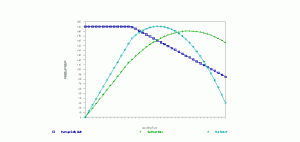
63. The rational manager of a wildlife population, for example bighorn sheep, would manage population levels in such a way
as to optimize reproductive rates. (a) true (b) false
64. The rationale livestock producer would have a strategy to stock at a level that produces the maximum output of red meat
per acre. (a) true (b) false
65. The rationale livestock producer would have a strategy to stock at a level that results in a level of individual animal
performance that approaches genetic potential. (a) true (b) false
66. Note the graph above. The rationale livestock producer would have a strategy to stock at the level where the average
daily gain response curve and the gain per area response curve intersect. (a) true (b) false
67. As variable costs increase, the rationale manager would increase stocking rate in order to cover additional expenses.
(a) true (b) false
68. Ruminants have three, fore-stomachs and one true stomach. (a) true (b) false
69. I remember one time – I believe it was ’63 – southern Sioux County in NW Nebraska. Normal growing season rainfall is
about 9 inches. ’63 rainfall was 2.57 inches. Soils are fine to very fine sandy loams. In 1964 the dominant aspect
vegetation was lambsquarter, an annual forb. (a) perennial plants failed to re-seed themselves. (b) lambsquarter is less
n-efficient than the perennials blue grama, prairie sandreed, sand bluestem and needleandthread grass. (c) if
you were to visit this area in 2000, you would still see 20 to 25 percent lambsquarter in the stand, but the grasses would
comprise the bulk of the composition.
70. Give an example of a measure of forage quality. TDN or Crude Protein
71. Give an example(s) of an indicator(s) of forage quality leaf, green and variety among life forms
72. Give an example of a nutritional standard 13 % dietary crude protein to meet the need of a 1200 lb animal for moderate
levels of lactation
73. Animals should never experience periods of under nutrition (weight or fat loss), based on nutritional standards. (a) true
(b) false