CENTRAL ORGANIZING IDEA: Rangeland vegetation is renewable. Rangeland plants have mechanisms to resist the impact of defoliation like fire and grazing. Grazing and Fire modify physiological processes (individual plant, autecology) and multiple-scales processes (plant community/landscape, synecology). The effect of modifications cascades through the ecosystem and across landscapes.
Objectives [numbers in brackets cross-reference with goals]
[2,5,6]Objective 1. Insure that all students have a base level of knowledge of how plants grow and reproduce.
[2,3,4]Objective 2. Insure that students have a base knowledge of how plants, monocots and dicots (including woody stems) respond to herbivory. For example, the importance of mechanisms to support apical dominance and how that interacts with morphology to induce tillering, etc.
[3,4,5,6]Objective 3. Give students some ideas of how managers might manipulate intensity, frequency and timing of defoliation to allow maximum ecological expression for a target species; or, how these might be used to sustain the health of other plants. Discuss Carbon allocation in the plant in response to abiotic and biotic factors.
[3,4,5,6]Objective 4. Introduce students to the process of developing alternate management strategies for different desired future conditions
TEACHING POINTS
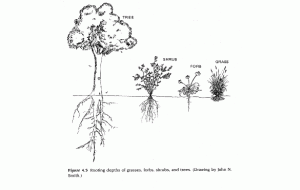
Global: Response of an individual plant to herbivory under natural conditions depends on frequency, intensity and timing of defoliation in relation to phenological development, associated plants, individual species’ characteristics (morphogenesis) and opportunity to compensate for herbivory (environment). See Figure 5.10 in Holechek et al.
1. All plants have mechanisms to resist and compensate for the impact of herbivory, some related the plant and some to the animal. Contrary to myth perpetuated in the past 2 decades, plants do not have to be grazed to survive; they probably do not show an optimum response to herbivory.
2. Opportunity to produce photosynthate and to compensate for herbivory is more critical than frequency and intensity of defoliation. Longer periods of effective rest are required as frequency and intensity of herbivory increase. [I use the rule-of-thumb a “healthy” plant must achieve 20 to 30 % of growth or regrowth to maintain a competitive position in the stand. Contrary to common belief, range readiness is a myth, and more often than not, results in negative plant impact; take-half, leave-half is an inadequate rule-of-thumb and has little relation to plant response to herbivory (the idea roots are not impacted under 50% root removal is a myth; see Milchunas and Lauenroth).
3. Shrubs may be more sensitive to herbivory than the herbaceous layer and require greater periods of compensation. This is especially true of cold desert shrubs; maybe less true of montane or sub-humid shrubs. Many shrubs invest heavily in secondary compounds as a mechanism to resist herbivory.
METHOD:
Objective 1 and 2. Assign chapters 2, 3, 4
Chapters 16, 17 and 18 give management examples;
we will refer to the contents of these chapters often
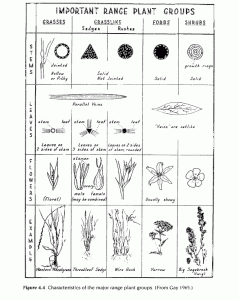
Tell how individual plants (organisms) respond to herbivory. Give two lectures on how grasses, forbs and shrubs grow and reproduce. Talk about photosynthesis, nutrient requirements and water use. Introduce the difference between C3 and C4 processes/metabolism.
Tell how individual plants respond to herbivory in a matrix of other plants (community). Tell how the defoliation axis (frequency, intensity and time [opportunity for regrowth] interacts with phenological development, morphogenesis, associated species and environment to affect the response of organisms in the community.
Test knowledge with short tests. Correct incorrect models with short lectures. Insure understanding with follow-up quizzes and examples using in-class writing exercise. [for example, students would be asked to write in their notes response to question like, “a cool fire removes aboveground phytomass of bluebunch wheatgrass on May 10 in the High Desert region of Eastern Oregon” The growing point is about 3 inches above ground level]. What do think would happen to the plant? die? continue growing at the point the fire disrupted processes? initiate new tillers, but eventually die? old tillers would die? initiate new tillers and continue life processes?]
RANGE PLANT ECOPHYSIOLOGY AND MORPHOLOGY
AS RELATED TO ENVIRONMENTAL STRESSES
Dr. Trlica
I. Introduction
A. Stress vs Strain
Stress – External applied factor to plant, i.e., heat, cold, nutrients, drought, defoliation, etc.
Strain – Plant responses to applied stress, i.e., Ps, growth rate, death rate, seed production, etc
[Joe, later on I talk about modifiers of species performance vs disturbers. Disturbance removes organisms from the system and creates a “gap.” Species modifiers change the equitability among plants/species]
B. Abiotic Stressors
1 . Water Availability
Excess – O2 may be deprived (waterlogged soil). Nutrient uptake and
growth reduced.
Drought – Periodic, interrupts life processes
Seasonal, production and vigor
Long-term, production, species composition
2. Water Availability
Excess – Nitrogen burns vegetation and stunts growth
Heavy metals produces toxicity
Limiting – Affects plant physiology; nutrients needed in construction and
biochemical reactions
C HOPKINS CaFe Mg – Known to be required
Cu, B Zn, Mo, Si, Se, etc are often required by some plants
Reduction in photosynthesis, growth and reproduction.
3. Light Availability
Light usually not limiting on semiarid and arid rangelands
Shading caused by tree or shrub overstory may limit understory production. Tallgrass prairie or bunchgrasses with high leaf area may shade understory plant parts.
Too much light may cause chlorophyll destruction and other tissue damage.
High light & high temperatures often interact.
4. Temperature
Cold – freezing injury can disrupt proteins, membranes,
cells die.
– water cavitation in xylem.
High – protein denaturazation.
– increased respiration.
– photosynthesis response curve to temperature.
5. Fire
Kills living tissues and elevated meristems
Ash may act as a fertilizer for some nutrients (P, Mg, etc.). What about N, P, and S? If fire kills the plant, roots become a major source of nutrients.
Timing of burn and post fire conditions are critical
Management after burn critical
C. Biotic Stressors
1. Disease
Pathogenic microorganisms & viruses.
Insects can be transmission vector.
Rs often increases & Ps decreases.
Metabolism and growth often affected.
Death of individual organisms.
2. Defoliation
Leaf area removed
Wound respiration, Ps decreases
Show curve of Rs & Ps immediately following defoliation
II. Defoliation and Grazing effects on Plants
A. Defoliation vs Grazing
Clipping vs Grazing – clean, smooth break
Grazing – often tearing action, greater would.
B. Direct Effects
1. Removal of Leaf Area
LAI and harvesting schedule
Total Ps related to amount of leaf present
2. Decrease in Ts and Rs
Reduction in leaf area results in reduced Ts and total aboveground Rs, but root respiration may increase
3. Decrease in Ps
Total Ps declines because of reduced leaf area
As new leaf area increases, Ps also increases
If more light available, Ps increases
All factors considered, seasonal Ps probably less
4. Decrease in seed production
5. Does saliva benefit plant?
No plant growth regulators in saliva
C. Indirect effects
1. Tillering and Lateral Branching
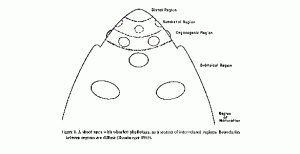
Removal of apical meristems stimulates development of lateral meristems. Branching increases.
2. Long shoots vs short shoots
Long shoots have stems – often reproductive
Long shoots more available, but less nutrition, i.e., more fiber and less nitrogen
Short shoots do not have elongated stems, leafy.
Short shoots near soil surface, high leaf:stem ratio, good nutrition, i.e., less fiber and more nitrogen
3. Canopy Architecture and Light
LAI – Leaf Area Index – Leaf Area/Ground Area
Shortgrass, tallgrass, forest comparison
LAI and light extinction
LAI and harvest schedule
4. Root Growth
Most occurs in early spring and early fall
Requires a carbon source
Root growth stops within hours or days of defoliation
Root growth resumes when sufficient leaf area has been produced
5. Root Exudation
Loss of photoassimilates accelerated after defoliation.
Exudates in form of sugars, amino acids, growth regulators.
Stimulates microflora in rhyzosphere.
As much as 25% of photoassimilates may be lost.
6. Trampling
7. Competitive Relations
III. Grazing and Plant Carbon Budgets
A. C3 and C4 Plants
C3 – 3 carbon acid (PGA) first product.
– cool season species.
– light saturated.
– not efficient in use of water or N.
– more primitive.
C4 – 4 carbon acid (malate) first product.
– warm season.
– not light saturate.
– efficient in use of water and N.
– more advanced, newer.
Response curves of C3 and C4 species.
Examples of each type for grasses, forbs, trees
CAM pathway
B. Translocation & Distribution of Carbon (C)
Translocated as sugar (sucrose), broken down, then used or stored for future use.
Translocation to active meristems, growth areas, or storage locations.
C. Carbohydrate Reserves
Stored primarily as starch, fructosan, inulin.
Stored in perenating organs (roots, tubers, stem bases).
Examples of U- and V-shaped curves.
Relation of curve shape with time of defoliation.
D. Positive and negative Balances
Plant must maintain positive C balance over time to survive.
Negative C balance during early and rapid growth, and following defoliation or fire.
IV. Management Factors to Control Grazing
A. Animal Numbers
Number and kind of stock
B. Grazing frequency
How often or how many times a plant or pasture is grazed; opportunity for plant to compensate for tissue removal.
C. Grazing intensity
How much plant material is removed. Often represented as a percentage or remaining after grazing or at the end of season.
D. Timing
Season of use. Tissue removal in relation to CHO cycle.
E. Selectivity
Animals select area, species and plant part to use. Some animals are more mobile than others, e.g., elk vs deer. Different animals select different plants at different times of the year. Some tend to include browse in their diets; others prefer mostly grass.
V. Grazing Myths
A. Range Readiness – time when grazing can commence
1. Phenological development
Considered time when plants are making most rapid growth.
It is advantageous for animal to use plants early, because they are more nutritious; then give them a chance to regrow. Use during period of most rapid growth to reproduction often worse than early or later.
2. Soil conditions
Wet soils are easily compacted. Animals slip and more mechanical damage to plants and surface. Streambanks may be more susceptible to damage when they are dry?
B. Grazing is beneficial to the plant
Plants can usually get along just fine without being grazed. Shift energy flow from the grazer pathway to detritus pathway. Rarely do grazed plants have greater net primary productivity than ungrazed plants; no evidence of increased fitness.
C. Take half – leave half
Natural Resource Conservation Service recommendation – conservative and usually applies to continuously grazed rangelands; measured at the end of the growing season.
Depends on timing, grazing system, etc
Dormant plants can withstand heavy use; reproducing plants can not withstand heavy use; plants can withstand heavy use during early phenology, if allowed ample opportunity to compensate under good growing conditions.
D. Critical CHO level
Don’t know these yet. It may be very low. CHO pools, per se, do not account for much of the variability in subsequent plant growth or regrowth.
VI. Grazing and Plant Growth
A. Leave sufficient leaf area
Leaf area to produce Ps for new growth demands
B. Opportunity for Regrowth
Depends on plant phenology, physiology, water, temperature, and nutrient availability.
C. Reduce Animal Selectivity
Accomplished with intensive grazing systems
Idea can be used to manage plant and structural diversity within a patch or community, or to manage plant and structural diversity at the landscape level while creating uniformity at the community level, often a requirement for habitat needs of some fauna. For example, the Mountain needs bare ground on open areas of low structure for nesting.
VII. No Grazing – The Answer?
A. Litter buildup
Mechanical interference with new growth, reduce light intensity, reduce red light.
Energy forced through decomposer pathway; nutrients turn over slow.
B. Tillering Reduced
Litter effect and production of auxin may reduce tillering. Fewer young plants, older and large tillers.
C. Compaction
Often soil compacted during growing season will become uncompacted with freeze-thaw cycles in winter.
D. Fire
Build up of plant mass & litter will increase fuel load. More likely to have a lot of hot wildfire at bad time.