CENTRAL ORGANIZING QUESTIONS/IDEA – HOW DO ANIMALS FIND AND UTILIZE NUTRIENTS TO MEET REQUIREMENTS FOR DIFFERENT COMPONENTS OF LIFE CYCLES? HOW DOES MANAGEMENT IMPACT ANIMAL-ANIMAL AND PLANT-ANIMAL INTERACTIONS?
OBJECTIVES:
Objective 1. Discuss the role of large herbivores in the ecosystem
Objective 2. Discuss the implication of the distribution of nutrients on rangelands in regard to the animal’s ability to meet requirements Nutrients vary in time and space. Animal requirements change throughout the year.
Objective 3. Review the components of grazing animal foods, which are important, which are nutritional, which are limiting, which are toxic, etc. How is the nutritive value of food estimated? Kind of plant-environment interactions.
Objective 4. Review differences in digestive tracts and ability of animals to extract and utilize nutrients sequestered in rangeland plants. How much can animals eat? Why?
Assignment: Chapter 11, Heady and Child
Optional. Holechek et al. 3rd Ed, Chapter 11
Teaching Points
1. Large herbivores remove and redistribute nutrients (feces, urine), modify ecosystem processes (e.g., reduce particle size and rate of decomposition), change rate of plant nutrient uptake (some evidence of higher rate of N uptake therefore, creates functional heterogeneity), can be a disturbance vis-a-vis hoof action, wallows, etc (including influence on mineral cycles), can kill some plants in the stand and create gaps, modify vegetation structure (hence habitat and the grazing decision environment), modify plant species performance, etc.
2. The impact of herbivory by large vertebrates reverberates throughout the ecosystem. They are modifiers of many patch-generating processes on multiple scales. Both invertebrates and small vertebrates are important patch generators in rangeland ecosystems. The dynamics of these patches are important to many plants and animals. These patches support a myriad of early to late seral plants. This is important for at least 2 reasons, (1) it increases the diversity of food nutrients available to all herbivores and reduces the risk of creating a nutritional bottleneck for any one species and extends the period of available high quality nutrients, and (2) it provides habitat for some fauna to complete critical components of their life cycles, e.g., the Mountain Plover needs early seral, short vegetation with bare ground for nesting habitat.
3. The bottom line is that animals must extract enough nutrients from plants to meet their basic requirements or needs during the year. That is the foraging challenge for all animals. Animals must find a way to deal with the temporal and spatial distribution of nutritional resources within the constraints of their nutritional requirements and ecophysiology. On an evolutionary time-scale animals must select plants in some optimal combination. Pragmatically, on proximal time-scales they must find enough to eat! Animals will experience both undernutrition and over nutrition throughout the annual cycle.
4. Movement is the key factor that allows animals to be adaptive and smooth temporal and spatial variation created by asynchronous generation and renewal of nutrients.
5. It is important to understand something about nutrition to understand how management can impact the well-being of animals. The digestive tract of most large rangeland mammals allow for the utilization of high fiber food. Animals are either rumen or cecal fermenters. That means they digest fibrous food and they can use low quality protein, even non-protein N, to supply N. Further, many animals efficiently recycle N in the body. The nutritional value of food is usually expressed in terms of digestibility and protein content. Ruminants are bulk limited; cecal fermenters are not.
6. In order to communicate you must know the definition of terms like digestible dry matter (DDM), digestible energy (DE), total digestible nutrients (TDN), crude protein (CP), neutral detergent fiber (NDF), cell wall constituents (CWC), acid detergent fiber (ADF) and lignin (ADL). You should know the name,Van Soest. You should know the words, “proximate analysis.” Nutritional entities are molecules and compounds need to sustain like. Chemical entities are used to approximate the value of foods.
7. Animals must consume a variety of plants, some of which will have nutrient contents higher than requirements and some of which will have nutritive content lower than requirements.
I. Animal requirements
A. Nutrients
B. Comparative nutrition
1. Comparison of ruminant and cecal digesters
2. Foraging ecology
C. Requirements vary throughout the year, because requirements are different for different components of the life cycle, e.g., maintenance vs reproduction and lactation, young vs mature, active vs less active.
Importance of nutritional bottlenecks.
1. Energy
a. what is the source of energy for animals with different digestive tracts?
simple gut – pig, human
ruminant – elk, cow, sheep
cecal fermenter – horse, elephant
b. energy partitioning, i.e., DE, ME, NE or ecologically, DE, A, R
c. energy requirements are proportional to BW0.75
d. all other nutrients in proportion to energy needs
e. gut capacity (GC) is proportional to BW1.0. The implication is that ratio of metabolic requirements (MR) to GC constrains the ability of the animal to obtain adequate nutrients from the environment
2. Protein
a. Protein degradation and use by animals with different digestive tracts
b. Ability of different animals to recycle N.
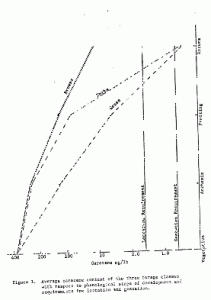
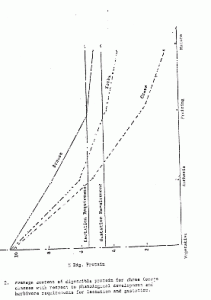
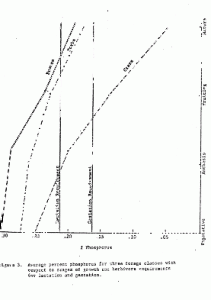
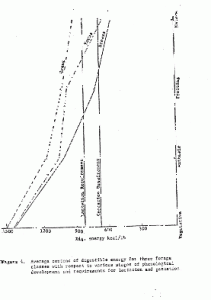
3. See Figure 11-1. Season can be divided into period when growth (G) > depletion (D), G = D or D > G. How do nutritional demands synchronize with availablility of limiting nutrient(s)?
D Many ways the animal adapts to environment, e.g., behavior/movement, seasonal change in metabolic requirements, compensatory ingestion, etc.
E. Must satisfy physiological needs. Physiological and social needs may be so important that nutritional needs are forfeited, e.g., predator avoidance vs feeding; thermoregualtion vs feeding.
F. Ingestion of nutrients is limited by digestive physiology and proportional to physiological requirements
II. Important Nutrients and methods of estimating nutritive value of forage tissue. Nutritional entities are rarely measured. We measure chemical entities that are either surrogates for the nutritional entity or are empirically related to the availability of the entity.
A. Proximate analysis to estimate TDN; digestible TDN approximates the digestible energy content of the feed.
B. Van Soest detergent method of Fiber analysis; divides tissue into cell contents and cell wall constituents.
C. Comparative value of plant parts and interaction with phenology and environment.
III. The foraging challenge
A. Animals must ingest nutrients from a variable resource. The challenge of the animal is find enough food with nutritional content greater than its requirements to mix with foods lower in nutritional content than it requirements to meet its requirement.
B. Grazing is not random. Animals return to areas with nutritionally high plants and avoid areas where nutrition or availability is low. Animals can discriminate, learn, remember and use memory to solve problems.
C. The more ways an animal can adapt to changing nutritional resources, the lower the risk of not achieving nutritional success.
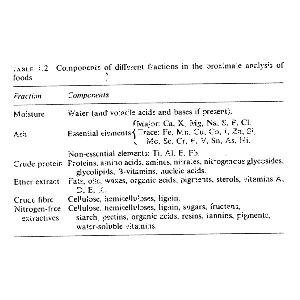
teaching points, re, Table 1.2
Determine chemical entities of the plant that can be used to estimate nutritive value
CP = N x 6.25; EE is 2.25 times the energy density of CP or CF
NFE is considered the carbohydrate fraction that is completely available to all higher animals. The fact is it often contains lignin (the assumed unavailable fraction of the plant) because some lignin was solubilized in preparation of Crude Fiber. CF assumed not available to simple gutted animals; variably available to ruminants and hind-gut fermenters.
Proximate Analysis is legal feed analysis in America
Total Digestible Nutrients (TDN) calculated from CP, EE, CF and NFE, because we know relative energy density and assume utilization (either constant or measured). TDN is an estimate of the available energy in a food, expressed either as a peccant or as pounds. That is one indicator of quality.
Empirically, TDN and Digestible Energy (DE) values are often similar.
Actual usefulness of TDN as a source of metabolizable energy for maintenance vs production is auto-correlated with the level of TDN. The higher the TDN value the greater for maintenance and production. Low TDN values indicate most of the energy goes for maintenance with proportionally less availability for production (growth & reproduction)
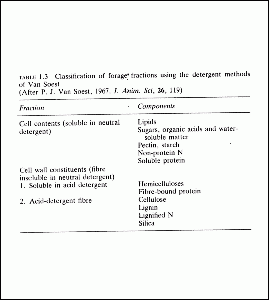
teaching point, re, Table 1.3
Determines chemical entities
Cell Contents (CC) assumed 98% digestible and high quality
Cell Wall Constituents (CWC) and Neutral Detergent Fiber (NDF) = same fraction
CWC/NDF is composed mostly of cellulose, hemi-cellulose and lignin; ADF is mostly cellulose and lignin
Assume most of the variability in digestibility can be accounted for by degree of lignification of cellulose fraction.
Cellulose + hemi-cellulose is holocellulose
Summative equation is, DDM = .98 CC + DCWC – 12.9, where DDM is digestible dry matter; DCWC is digestible CWC; 12.9 is the % of intake represented in fecal metabolic excretion (a constant).
RS300
Supplemental material
teaching points, re, Table 1.2
Determine chemical entities of the plant that can be used to estimate nutritive value
CP = N x 6.25; EE is 2.25x energy density of CP or CF
NFE is considered the carbohydrate fraction that is completely available to all higher animals. The fact is it often contains lignin (the assumed unavailable fraction of the plant) because some lignin was solubilized in preparation of Crude Fiber. CF assumed not available to simple gutted animals; variably available to ruminants and hind-gut fermenters.
Proximate Analysis is legal feed analysis in America
Total Digestible Nutrients (TDN) calculated from CP, EE, CF and NFE, because we know relative energy density and assume utilization (either constant or measured). TDN is an estimate of the available energy in a food, expressed either as a peccant or as pounds. That is one indicator of quality.
Empirically, TDN and Digestible Energy (DE) values are often similar.
Actual usefulness of TDN as a source of metabolizable energy for maintenance vs production is auto-correlated with the level of TDN. The higher the TDN value the greater for maintenance and production. Low TDN values indicate most of the energy goes for maintenance with proportionally less availability for production (growth & reproduction)
teaching point, re, Table 1.3
Determines chemical entities
Cell Contents (CC) assumed 98% digestible and high quality
Cell Wall Constituents (CWC) and Neutral Detergent Fiber (NDF) = same fraction
CWC/NDF is composed mostly of cellulose, hemi-cellulose and lignin; ADF is mostly cellulose and lignin
Assume most of the variability in digestibility can be accounted for by degree of lignification of cellulose fraction.
Cellulose + hemi-cellulose is holocellulose
Summative equation is, DDM = .98 CC + DCWC – 13.9, where DDM is digestible dry matter; DCWC is digestible CWC; 13.9 is the % of intake represented in fecal metabolic excretion (a constant).