NTRODUCTION
CENTRAL ORGANIZING QUESTION/IDEA: Why a discipline of Rangeland Ecosystem Science? The way we view the natural world and our relationship to it is largely cultural. The linkage between biological/ecological systems and human systems is critical, but the nature of that linkage is not homogeneous among individuals or societies. Managers facilitate that linkage. The manager is a communicator and organizes human, biological and physical resources to attain goals acceptable to society that meet the needs of individuals, while sustaining natural systems.
OBJECTIVES [numbers in brackets cross-reference with goals]:
[1]Objective 1. Explore the discipline. Explore the rationale behind disciplines and think about why we are housed in the College of Natural Resources.
[2,4,6,7]Objective 2. Explore how we communicate within a discipline and across disciplines, and how important communication is to management of rangeland uses and amenities.
[3]Objective 3. Explore management and the role of managers.
[3,5,6]Objective 4. Explore how biological systems and human systems are linked.
TEACHING POINTS (numbers cross-reference with objectives):
Global: This first unit is intended to introduce students to the discipline of Rangeland Ecosystem Science, challenge them to personally evaluate their relationship to the natural world, and describe the role of rangelands in global processes. How do we communicate?
1,2. Artificial land classification is a way to communicate. The word rangeland originated from a classification of land based primarily on use, similar to designations like forestland, cropland or wasteland. There is no universal definition. Rangelands are grasslands, shrublands, and savannahs. Further, areas that support these vegetation types on a transitional basis are sometimes called rangelands, depending on their use. Rangelands have both utilitarian and amenity value. Classification may or may not contribute to systems thinking.
1,4. Rangelands have intrinsic value, contribute to wealth, produce food and fiber, support a renewable resource, and often possess non-renewable resources.
1,2,3. The linkage between biological/ecological systems and human systems depends on your world view. People are not a homogeneous lot; managers are not a homogeneous lot. Managers are not value free. Everyone agrees management of natural resources should be based on the best science. The issue is that many science-cultures can be found; scientists are not value free. Stakeholders are a heterogeneous lot; they have many value and belief systems. Do disciplines facilitate the training of NR managers? Scientists? Does it follow that well trained biologists/ecologists will be good managers? Science and management exist in 2 different universes.
1,4 The approach to this class is to provide some foundational materials (organizing ideas or questions) and then show how these are used in management of ecosystems for amenities and uses. Alternative values are represented by bio/ecocentrists, theocentrists, anthropocentrists, technocentrists, etc. These result in different approaches (paradigms) to organization of data and information which, in turn, can result in different alternatives for decision-making. No approach can insure sustainability of managed or unmanaged systems. People’s value sets and behavior result from complex experiences with a plethora of influences and learning. As a result, cultures of thinking and behavior develop. We should expect values and paradigms to differ from bio-region to bio-region; among scientists trained in Colleges of Natural Sciences vs Natural Resources; among scientists trained at land-grant vs non-land grant Universities; managers who graduated from Texas A & M vs Colorado State; those who explain nature in terms of mythology/theology vs indigenous knowledge/experience vs science; western thought vs other thought; etc. Does that make any one culture wrong and the other right?
3. Management is a process; it is not a goal. Managers manipulate systems to achieve goals. Managers plan, control/implement, monitor and adjust/adapt.
1,2. Rangeland issues are often complex (messy situations) and problems are always open-ended, because of uncertainty in natural, economical and political environments. Decisions are always made in an environment of uncertainty. Problems are deviations from a standard or norm. Therefore, a problem is stated within the context of an issue.
1,3. Our basis for explaining variability and building a model to deal with it are the ultimate issues. We have chosen the ecosystem as the basis for analysis and intervention and the landscape as the spatial scale for most rangeland analysis and planning. The temporal scale is issue-dependent.
1,2,4. Decisions reflect the values of the agency or company we work with. Managers should expect, and learn to deal with, some tension between their value set, the company or agencies’ value set, and the public’s value set. Involvement in decisions outside our personal value set causes heartburn. Managers must learn to deal with complexity. Everyone comes to the table with a philosophical bias. Stakeholders represent many value sets and views. Managers face the issue of empowerment in every situation encountered. Yet, in most situations “no decision” is an unacceptable option.
ASSIGN: Chapter 1 (WebCT, See Chapter 01 under the Introduction)

| Implementing Ecosystem-Based Management. 1993. BioScience 43:612 |
The following came from Joyce Berry in Forest Science; I do not know her reference |
| Main components of an ecosystem approach: |
Important Elements of Ecosystem Management |
| * describe parts, systems, environments and their interactions, |
* Whole systems vs single systems |
| * are holistic, comprehensive, and transdisciplinary |
* Protection first, use second |
| * include people and their activities in the ecosystems |
* Scarcity, not plenty |
| * describe system dynamics through concepts such as stability and feedback |
* Integration of people and nature |
| * define the system naturally, for example, bioregionally, instead of arbitrarily |
* Collaboration |
| * look at different levels and/or scales of system structure, process, and function |
* Shared decision making |
| * recognize goals and take an active, management orientation |
* Science-based management |
| * incorporate stakeholder and institutional factors in the analysis |
|
| * use anticipatory, flexible research and planning process |
|
| * entail an ethics of quality, well-being and integrity and, |
|
| * recognize systemic limits to action – defining and seeking stability |
TASK 1. To facilitate learning, students will be asked to develop independent world-surface classification schemes. They will participate in individual introspection. They will be asked to think critically about the institutions they are associated with. Write in your notes words to communicate differences in the surface of the earth. In other words, classify the earth’s surface so you can communicate to a diverse audience. This exercise illustrates the way we view a system and the way we might interact with the system.
Classification 1.
Classification 2
TASK 2. Let’s take a closer look at the discipline. To facilitate the discussion, please read Chapters 1, 2, and 3 in Holechek et al; or, Chapter 1 in Heady and Child. Please answer the following questions:
Holechek et al. define rangeland as, “uncultivated land that will provide the necessities of life for grazing and browsing animals.” Compare to Heady and Child, page 1, paragraph 1.
Figure 1.2 in Holechek et al. is given below. Contrast with Figure 1-1 in Heady and Child.
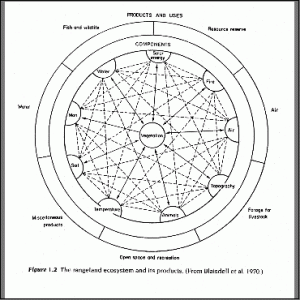
What are the central organizing ideas on which the discipline is founded? [hint: look at the Table of Contents in Heady and Child; at least this gives a clue to how they view the discipline]. How does the Heady and Child outline differ from the RS300 course outline?
Are Heady and Child biocentric, ecocentric, anthropocentric, technocentric or theocentric in focus?
What is range management?
What is rangeland ecosystem science?
TASK 3. Write in your notes the philosophies that separate the College of Natural Sciences (CNS) from the College of Natural Resources (CNR). Why isn’t this class taught in the CNS? Is “science” in CNS different from “science” in CNR?
TASK 4. Life experiences shape our belief and value systems. Hopefully, all of us modify our behavior over time as we gather new information and have new experiences. If asked to describe yourself in 2 or 3 words, what would you say? How consistent is that description with your past? Where are you coming from? Which global belief motivates your view of the way the world is organized; and hence, your behavior (or, your belief/response/value system)?
For example, I describe myself as a pragmatic realist. I am a Caucasian male, married with 4 children and 9 grandchildren. I have lived with my first wife for 38 years. I have 1 younger sister. I was raised in a Judeo-Christian home. My parents were both living during my adolescence. I was surrounded by a very large extended family. There have been no divorces in my immediate family. I grew up very rural (we used to walk back toward town to hunt). We lived in a below-ground house. Until I left for High School, we had no indoor facilities, refrigeration or electricity. I boarded out to go to high school. We lived too far from town to commute, and no one had heard of a school bus. WWII had a dramatic impact on our family. My father (now deceased) was a disabled veteran of WWII. My family roots were in agriculture. We had to depend on the land for our livelihood. One side of my family established a tree claim and the other a homestead in the sandhills of Nebraska. My educational linage is Utah State University and the University of Nebraska. Professionally, I have been at The University of Nebraska, Oregon State University, Texas A&M University and Colorado State University. I was affiliate faculty at The Institut Agronomique & Veterinaire Hassan II, Rabat; and, The University of Zimbabwe, Harare. I lived in Morocco for 1 year and Zimbabwe for 3 months. I have consulted in Morocco, Zimbabwe, Kenya, Tanzania, Iceland, Peoples Republic of China, France, Kyrgzstan, Kazhakstan and traveled in Europe, Great Britain, Australia and New Zealand, Mexico and Canada. I am a member of the East Anatolio Watershed Training project, Turkey.
How do you describe yourself? List some bullet points
| 1. | 10. |
| 2. | 11. |
| 3. | 12. |
| 4. | 13. |
| 5. | 14. |
| 6. | 15. |
| 7. | 16. |
| 8. | 17. |
| 9. | 18. |
Here is who I am (2 or 3 words) _______________________________________________
TASK 5. Short lecture on managers and management. Examples in this class are drawn from experience with managed systems.
Rangeland issues are often complex (messy situations) and problems are always open-ended, because of uncertainty in natural, economical and political environments.
Management is an adaptive process. Within this environment of uncertainty, we want the assurance the system represents the desired state or is transitioning toward the desired future condition.
Respond to the following:
“Agroecosystems are managed ecosystems. Agriculture, by its very nature, involves a self-conscious attempt by humans to change or manage natural ecosystems. The fundamental purpose of agriculture is to shift the ecological balance so as to favor humans relative to other species in production of food and physical protection. Humans are unique among species in that we make purposeful, deliberate decisions that can enhance or degrade the health of the ecosystems of which we are a part. Thus, any assessment of the sustainability of agroecosystems must take into consideration the purposeful, self-conscious nature of individual and collective human actions.
The key to stopping and reversing environmental degradation is to change the action-response patterns of humans. The fundamental nature of the human species is not more changeable than are the fundamental laws of nature. However, the ability to learn, to discover new options, and to choose new responses are, in fact, fundamental aspects of human nature. Thus, any study of ecosystem sustainability must include the study of intentional human actions. From a systems perspective, humans are the only actors in agroecosystems capable of self-conscious, intentional actions necessary for sustainability.” John Ikerd
Paragraph 1 under rangeland deterioration (page 5, Heady & Child) is a description of rangelands (pre-european, American?) and impact of use over the past few decades. The most I can say, from a personal perspective, is that this paragraph and the one above represent many teaching opportunities. You read the paragraph and we will discuss.
This class will explore the ecological basis and constraints for rangeland ecosystem manipulations and discuss alternatives to bio-engineered ecosystems to meet human and intrinsic needs. Rangeland ecosystem management issues are always open-ended; they are always addressed in the context of the primary, secondary, tertiary, etc stakeholders and the firm or agency involved.
The manager cannot escape social, economic and political influences. She/He deals with bio-regional values (culture), cultures of scientists (again, whose science is correct/best?), cultures of managers (each bring their own value set to the table), cultures of world-order explanations (mythologists, a myriad of religious beliefs, traditions, etc).
Management is a sequential adaptive process. Managers try to explain variability and then plan to meet some intended goal(s). Because systems are open, planning must occur on different levels, e.g., strategic, tactical and operational levels. The real question of the manager is what do I measure to know objectives are being achieved, and how long do I let the system run between measurements?
ASK 6. This exercise will introduce students to biological/ecological complexity and open-ended problems. It will introduce students to the kinds of issues they might encounter in the real world and give them models to identify problems.
SKILL: demonstration of open-ended problems
RS300F98
Takehome exercise
WHAT IS THE PROBLEM?
“From the day we introduced the computer, we’ve had nothing but trouble in getting our inventory to balance. I just don’t understand it.”
“Our number eleven paper machine never produces more than 80% of its design capacity no matter what we try.”
“The system worked well for months. Then in the middle of the morning three weeks ago, it went dead. It is still dead and we don’t have the slightest idea of what happened.”
“There is no way we can meet our deadline on the project with our present staff and no way we can get authorization to bring on anyone new. This is a serious problem!”
“I finished the analysis on the McGregor Unit this morning. Most of the east side was in Fair condition. The problem must be the location of the water.”
“In my professional opinion the stream channel is much wider than I would expect on this reach. The problem is the season of use by cattle. Further, the problem seems to one of inadequate livestock distribution.”
“Horses are a problem. They are incredibly destructive animals. They have both upper and lower incisors and can bite close to the ground.” Their numbers should be reduced by at least one-half.”
Scenario to illustrate problem identification vs issues, symptoms and solutions
The Picketwire Canyonlands (PWC), located in southeast Colorado, are administered by the USDA Forest Service. A legislative act transferred jurisdiction from the Department of the Army (DOA) to the FS. Department of the Army (DOA) purchased the ranch as part of the Pinion Canyon Maneuver Site. The PWC encompasses about 10 or 11 miles of the Purgatory River in a band about 1 mile wide.
The area is rich in ancient and recent cultural history. More than 1000 petroglyphs and some pictographs are known in the canyon. Evidence of Spanish occupation of the canyon is common. Remnants of an early 20th century church and cemetery with hand carved headstones are still intact; the old ranch house and outbuildings are restorable. The longest continuous, exposed dinosaur track in the world is found in the bed of the Purgatory River. This track provided the first evidence of social oganization among family groups in dinosaurs.
Motorized access to the area is restricted. The area is open to non-motorized access, e.g., on foot, horseback or mountain bike. Illegal artifact removal and defacing of rock art is always a concern. Grazing is allowed only if a benefit can be shown. The FS has not permitted any animals in the PWC, but some trespass grazing by cattle is known.
When purchased by the DOA, all ranching operations were simply abandoned. Current vegetation reflects past use. Improperly grazed areas remain in early seral to mid seral state; abandoned fields reverted to annual forbs like Kochia spp. or annual grasses like cheatgrass. A few areas support early-seral perennials, like sand dropseed. Many areas support a mix of mid to late seral vegetation.
In some years the fuel load exceeded 3,000 kg/ha, creating extreme fire danger. In fact, in April 1996, a fire raged in the Canyon for several days and burned nearly 10,000 acres. The fire had a profound impact on resources in the Canyon. Fuel, mostly in the form of litter, was totally removed.
The flood plain along the Purgatory River consists of a riparian area directly adjacent to the stream and sandbars and other mixed deposits are found on the first terrace above that. The riparian supports mid and tall grasses and dense tamarisk. The terrace is characterized by late seral cottonwoods and variety of herbaceous plants (mid seral/alien) and sparse cottonwood regeneration. The April fire killed a large percentage of the mature cottonwoods. The herbaceous understory is composed of kochia and other undesirable annual weeds. Desirable perennial grasses and forbs are sparse to nonexistent. Considerable evidence of past disturbance, i.e., agronomic activity, is still visible.
Common wildlife include white-tailed deer, mule deer, turkey, quail, many ground nesting birds, neo-tropical birds, elk, cougar, big-horn sheep and probably others.
TASK: Define the problem(s)