RS300
Quiz
11-12-99
1. All ruminants have a selective delay mechanism that limits the amount of feed they can eat in one day. That means a sheep’s total voluntary intake varies little throughout the year (a) true-true (b) false-false (c) true-false (d) false-true .
8. Metabolic requirements (MR), per unit of body size, of large animals are MR for small body-size animals. (a) greater than (b) lessor than
9. Ruminants have three, forestomachs and one true stomach. (a) true(b) false
11. Elk (ruminants) are bulk limited, i.e., total intake (g/day) is constrained by a selective delay of particles escaping the rumen. Total voluntary intake of a ruminant is quite independent of forage quality. (a) true-true (b) false-false (c) true-false(d) false-true.
12. The amount a non-ruminant eats is independent of physiological requirements, for example, lactation [milk production]. (a) true(b) false
13. TDN [Total Digestible nutrients] is an estimate of the available energy content of a food. The procedure to determine TDN is basically a acid-base hydrolysis. (a) true-true (b) false-false (c) true-false(d) false-true
14. Microbes secrete extra cellular enzymes to break down cellulose and/or hemi-cellulose. Cell Wall Constituents (CWC) are an empirical extraction that represent the fiber content of the plant. (a) true-true (b) false-false (c) true-false (d) false-true
15. Carbohydrates are composed of carbon, hydrogen, and oxygen. (a) true (b) false
16. Ruminant animals do not have a dietary need for fat or water soluble vitamins [exceptions include Carotene (Vitamin A), because it cannot be stored for extended periods of time; and D, if animals not exposed to sunlight]. Ruminant animals do not have a need for trace minerals.(a) true-true (b) false-false (c) true-false (d) false-true
RS300
Quiz
11-15-99
1. Volatile fatty acids (the end-product of microbial fermentation) are the primary energy source for ruminant herbivores. (a) true (b) false
2. Volatile fatty acids (the end-product of microbial fermentation) are the only source of energy source for herbivores with a cecum. (a) true (b) false
3. A reasonable range of crude protein values (percent) for graminoids (grasses) might be (a) 0 to 4 (b) 45 to 70 (c) 3 to 25 (d) 16 to 42
4. If no other data were available, 2 percent of body weight would be a reasonable estimate of the daily dry matter intake of a free grazing animal, ruminant or non-ruminant. (a) true (b) true
5. Ruminants have a selective delay mechanism that limits the amount of feed they can eat in one day. A ewe supporting 2 lambs would eat more dry matter per day than one supporting 1 lamb. (a) true-true (b) false-false (c) true-false (d) false-true
6. Cellulose and hemi-cellulose cannot be broken down by enzymes. Cell Wall Constituents (CWC) are an empirical chemical extraction that represent the total fiber content of the plant. (a) true-true (b) false-false (c) true-false (d) false-true
7. Browse is typically higher in crude protein at the end of the growing season than grass. Browse is typically higher in phosphorus and Carotene at the end of the growing season than grass. (a) true-true (b) false-false (c) true-false (d) false-true
8. Digestible energy content of big sagebrush can be high, e.g., 65% DE. Yet, if offered only a diet of sagebrush, a sheep would die of malnutrition. Why? (don’t use the word palatable in your response)
Because sagebrush is high in “essential oils.” The compounds are absorbed [digested], but not utilized.
9. Grasses that grow under conditions conducive to production of large amounts of biomass are composed of _____________ fiber than those grown under conditions conducive to production of less biomass.(a) more (b) less
10. Rate of passage of dry matter in animals without a rumen digestion system is generally slower than in those with a rumen digestion system. Extent of digestion of medium to low quality dry matter or energy is less in a non-ruminant than a ruminant. (a) true-true (b) false-false (c) true-false (d) false-true
11. Microbes secrete extra-cellular enzymes to break down cellulose and/or hemi-cellulose. Cell Wall Constituents (CWC) are an empirical extraction that represent the fiber content of the plant. (a) true-true (b) false-false (c) true-false (d) false-true
12. Carbohydrates are composed of carbon, hydrogen, and oxygen (a) true (b) false
13. Proteins are composed of amino acids linked by peptide bonds. (a) true (b) false
14. Ruminants require a balance of amino acids in the diet. (a) true (b) false
15. Leaves of nearly all forages have higher crude protein, phosphorus and cell contents, and lower fiber and lignin levels than those of stems. (a) true (b) false
16. Persistent leaves tend to have more anti-quality compounds than deciduous leaves. (a) true(b) false
Deciduous leaves also have anti-quality compounds.
17. I completed a metabolism trial on grass hay fed to bighorn sheep. The digestion coefficient was 88%. (a) that is within the range I would expect (b) The value is comparatively low (c) the value is comparatively high
18. I received an analysis of a sample of forage collected via an esophageally cannulated cow. The NDF was 63%.(a) that is within the range I would expect (b) The value is comparatively low (c) the value is comparatively high
19. Crude fiber is a common source of energy for all mammals. Amino acids represent nutritional entities of a plant. (a) true-true (b) false-false (c) true-false (d) false-true
20. Animals choose foods based on the nutritional value of the food. Animals select foraging locations based on value of food in that area. (a) true-true (b) false-false (c) true-false (d) false-true
21. On self-organization. Behavior by consequences. The order and behavior of systems emerge from their own functioning, not from that of their surroundings, and the system’s functional integrity is the variable that is maintained. Self-organizing systems create order out of chaos without need to invoke external intervention or goals. There are no inputs or outputs in a self-organizing system – no distinctions between antecedents and consequences – merely circular arrangements of functionally connected components. Hierarchies of organization and high level goals reflect the observer’s logic, not the system’s functioning, and constructions regarding causation are merely metaphors of control…that reflect the theorist’s framework of assumptions as well as the limitations imposed by observational methods. So, in the grand scheme of evolutionary fitness, would you rather be optimal or adaptive? Just something to think about. Sign up for RS352 or RS552. We’ll discuss it some more.
RS300
Quiz
11-29-99
X. Managers use 3 ideas to direct succession.
1. Manage soil nutrients
2. Manage species colonization
3. Manage species performance
4. As long as G > D, the main concern of the managers is total available dry matter.(a) true (b) false
That does not necessarily imply absolute requirement is met in relation to the genetic potential of the animal. Under free-grazing conditions “you take what you can get.” Of course, one of the challenges of the manager to create a designer landscape that most closely produces nutrients that meet a target animal’s needs.
5. Nutritional content of all plants on an area must be above the animal’s requirement in order for the animal to meet its nutritional needs. (a) true(b) false
The challenge of the free-grazing animal is to find enough of those high quality nutrients to mix with more abundant lower quality nutrients to still meet their need.
6. One method to regulate and/or insure animals can meet nutritional requirements to complete different components of the life cycle is to manipulate herbage allowance. How is herbage allowance expressed?
Lb/AUD or multiples of intake per AUD
RS300
Quiz
12-01-99
X Managers use 3 ideas to direct succession.
1. manages soil nutrients
2. manages colonization
3. manages individual species performance
4. As long as G > D, the main concern of the managers is total available dry matter. (a) true (b) false
5. Nutritional content of all plants on an area must be above the animal’s requirement in order for the animal to meet its nutritional needs. (a) true(b) false
6. One method to regulate and/or insure animals can meet nutritional requirements to complete different components of the life cycle is to manipulate herbage allowance. How is herbage allowance expressed?
Pounds/Animal Unit Day or in multiples of intake per AUD
RELATIONSHIP BETWEEN STOCKING RATE, ANIMAL PERFORMANCE, RISK AND ECONOMICS
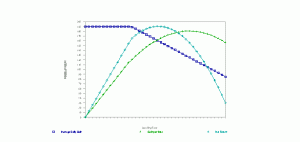
7. The rational manager of a wildlife population, for example bighorn sheep, would manage population levels in such a way as to maximize reproductive rates. (a) true (b) false
Would require harvesting to maintain very low populations. That level of harvesting impact genetic diversity and put the herd in peril if a disease outbreak.
8. The rationale livestock producer would have a strategy to stock at a level that produces the maximum output of red meat per acre. (a) true (b) false
No, because net return would be less than some lower stocking rate. The statement might be true if no variable costs.
9. The rationale livestock producer would have a strategy to stock at a level that results in a level of individual animal performance that approaches genetic potential. (a) true (b) false
Would make no since, because adding animals would continue to increase net return up to some point.
10. Note the graph above. The rationale livestock producer would have a strategy to stock at the level where the average daily gain response curve and the gain per area response curve intersect. (a) true(b) false
The intersecting point is meaningless; depends on scale of dependent variables.
11. Is the animal at risk when livestock concentration is high and >80% of the food contains nutrients in concentration greater than requirements for that component of the life cycle? (a) almost certainly (b) no, only if they are forced to stay on the area too long
12. As the cost of operating increases, the rationale manager would increase stocking rate in order to cover additional expenses. (a) true (b) false
No, the rationale manager would decrease stocking rate. Granted, would be less total revenue, but maximum possible would happen at lower stocking rate.
RS300
Take home
12-08-99 (12-10-99)
1. The greater the amount of ungrazed forage at the end of the season, (a) the higher (b) the lower average daily performance of the animal.
2. In an economic production system, a rancher would always stock at a level to insure maximum output of red meat per acre. (a) true (b) false
3. Which has the greatest influence on stocking decisions in an economic system? (a) fixed costs (b) variable costs
Fixed costs do not enter the stocking rate decision….Why?
4. The stocking rate (SR) that produces the greatest net return ($) will always be (a) > the SR that maximizes offtake (b) < the SR that maximizes offtake (c) >the SR that maximizes individual animal performance
5. Which would have the greatest impact on stocking decisions? (a) selling price (b) variable costs (c) neither – equal impact (d) neither – irrelevant
In fact, it can shown the ratio of VC/SP is directly related to choosing the optimal stocking rate
6. Volatile fatty acids (the end-product of microbial fermentation) are the primary energy source for ruminant herbivores. (a) true (b) false
7. The leaves of most forages have higher crude protein, phosphorus and cell contents and lower fiber and lignin levels than those of stems. (a) true (b) false
8. Elk (ruminants) are bulk limited, i.e., total intake (g/day) is constrained by a selective delay of particles escaping the rumen. Total voluntary intake of a ruminant is independent of physiological status. (a) true-true (b) false-false (c) true-false (d) false-true
9. Grasses that grow under conditions conducive to large biomass production have (a) more (b) less fiber content than those grown under conditions conducive to less biomass production.
10. Metabolic requirements are directly proportional to body size (a) true (b) false
Metabolic requirements for what? I was thinking energy when I wrote the question. Requirements are proportional to body weight raised to the 0.75 power.
11. Rate of passage in large-bodied ruminants is generally slower than in small-bodied ruminants. (a) true (b) false
12. Cellulose is an example of a nutritive entity. A nutrient is a molecule or compound needed to sustain life. (a) true-true (b) false-false (c) true-false (d) false-true
13. Most plants are extremely susceptible to grazing. Deer response to grazing pressure or stocking rate is fundamentally different from sheep response to grazing pressure. (a) true-true (b) true-false (c) false-true (d) false-false
14. According to the empirical, graphical representation of offtake (lb/acre) to stocking rate (AUMs per acre), each additional AUM, beyond a critical number, results in an incremental accumulation of offtake at a decreasing rate to some maximum, then declines at an increasing rate. (a) true (b) false
15. Volatile fatty acids (the end-product of microbial fermentation) are the only source of energy source for herbivores with a cecum. (a) true (b) false
16. A reasonable range of crude protein values (percent) for graminoids (grasses) might be (a) 0 to 4 (b) 45 to 70 (c) 3 to 25 (d) 16 to 42
17. If no other data were available, 2 percent of body weight would be a reasonable estimate of the daily dry matter intake of a free grazing animal, ruminant or non-ruminant. (a) true (b) true
18. Ruminants have a selective delay mechanism that limits the amount of feed they can eat in one day. A ewe supporting 2 lambs would eat more dry matter per day than one supporting 1 lamb. (a) true-true (b) false-false (c) true-false (d) false-true
19. Cellulose and hemi-cellulose cannot be broken down by enzymes. Cell Wall Constituents (CWC) are an empirical chemical extraction that represent the total fiber content of the plant. (a) true-true (b) false-false (c) true-false (d) false-true
20. Browse is typically higher in crude protein at the end of the growing season than grass. Browse is typically higher in phosphorus and Carotene at the end of the growing season than grass. (a) true-true (b) false-false (c) true-false (d) false-true
21. Proteins are composed of amino acids linked by peptide bonds. (a) true (b) false
22. Ruminants require a balance of amino acids in the diet. (a) true (b) false
23. The empirical chemical fraction named crude fiber is part of the (a) Proximate Analysis. (b) Van Soest Analysis
24. I completed a metabolism trial on grass hay fed to bighorn sheep. The hay was harvested at seed ripe stage of maturity. The digestion coefficient was 88%. (a) that is within the range I would expect (b) The value is comparatively low (c) the value is comparatively high
25. I received an analysis of a sample of forage collected vis a vis an esophageally cannulated cow. The NDF was 63%. (a) that is within the range I would expect (b) The value is comparatively low (c) the value is comparatively high
26. Crude fiber can be used by ruminants as a source of energy. It is nearly completely digested in the rumen. (a) true-true (b) false-false (c) true-false (d) false-true
27. The content of fiber in grasses declines rapidly with plant or tiller maturity. (a) true (b) false
28. The content of crude protein in grasses declines rapidly with plant or tiller maturity. (a) true (b) false
29. The nutritional requirements of animals in relation to different growth or production stages are (a) growing< mature (b) growing > mature (c) producing > maintenance (d) producing < maintenance
30. Percentage crude protein is percentage crude fiber x 6.25. (a) true (b) false
It is N x 6.25
31. Plot the relationship between grazing pressure (AUD/lb) [the independent variable] and average daily gain [the dependent variable].
IX. We’ve talked about 3 environmental factors that managers can manipulate to direct succession. List them.
34. manage soil nutrients
35. manage individual species performance
36. manage colonization
XX. For purposes of monitoring grazing impact on animal performance, I have suggested 5 important variables a manager might consider. Mark the risk of an animal NOT being able to find high quality nutrients.
| risk | |||
| 37. | Livestock concentration index high (>8)vs low (<3) | high | low |
| 38. | Length of graze period short vs long | high | low |
| 39. | Standing crop of forage is little vs lots | high | low |
| 40. | Stocking changes from normal to greater than normal | high | low |
41. Given a cow-calf operation. Income is derived from sale of calves. Is it possible to stock at a rate that maximizes individual animal performance and net return? (a) yes (b) no
42. Rest means no grazing during a calendar year. (a) yes (b) no
43. Remember the ecosystem rules? Negative feedbacks (a) are system organizers (b) allow transition to a different state.
44. Supplemental N in a system tends to encourage late seral splants. (a) true (b) false
XX. The challenge of the grazer is to find enough plant tissue with nutrient concentration greater than the animal’s requirement to mix with plant tissue with nutrient concentration less than the animal’s requirement such that the animal meets its requirement. Which of the following would be the worse-case scenario in regard to individual animal response? This is a multiple-pasture, 1 herd SDG plan (i.e., peak standing crop 500 lb/acre; stocked at 6 acres/AUM; 120 day grazing season)
(45) <25% of nutrients above animal requirement, livestock concentration index high (LCI > 10), days graze = 9 (long)() > 80% of nutrients above animal requirement, livestock concentration index low (LCI = 3), days graze = 5 (moderate)
() >80% of nutrients above requirements, livestock concentration index high (LCI = 18), days graze =3 (short)
48. Lignin is that chemical fraction of a food considered to be completely indigestible. (a) true (b) false
49. Cellulose and hemi-cellulose can be broken down by enzymes. Cell Wall Constituents (CWC) are an empirical chemical extraction that represent the total fiber content of the plant. (a) true-true (b) false-false (c) true-false (d) false-true
50. Crude fiber is a common source of energy for all mammals. Amino acids represent nutritional entities of a plant. (a) true-true (b) false-false (c) true-false (d) false-true
51. TDN [Total Digestible nutrients] is an estimate of the available energy content of a food. The procedure to determine TDN is basically a acid-base hydrolysis. (a) true-true (b) false-false (c) true-false (d) false-true
52. Microbes secrete extra cellular enzymes to break down cellulose and/or hemi-cellulose. Cell Wall Constituents (CWC) are an empirical extraction that represent the fiber content of the plant. (a) true-true (b) false-false (c) true-false (d) false-true
53. Carbohydrates are composed of carbon, hydrogen, oxygen and nitrogen. (a) true (b) false
54. Ruminant animals do not have a dietary need for fat or water soluble vitamins [exceptions include Carotene (Vitamin A), because it cannot be stored for extended periods of time; and D, if animals not exposed to sunlight]. Ruminant animals do not have a need for trace minerals. (a) true-true (b) false-false (c) true-false (d) false-true
55. Leaves of nearly all forages have higher crude protein, phosphorus and cell contents and lower fiber and lignin levels than those of stems. (a) true (b) false
How well do animals with different digestive tracts utilize the following compounds/nutrients? Write “C” for complete or nearly complete, write “V” for variable and write “N” for not at all or nearly so
|
Compound/Nutrient |
Kind of digestive tract | ||
| Simple gutted | Ruminant | Cecal Digester | |
| Hemi-cellulose | N | V | V |
| Cellulose | N | V | V |
| Cell contents | C | C | C |
| Amino acids | C | C | C |
| Cell wall constituents | N | V | V |
| Simple sugars | C | C | C |
| Starches | C | C | C |
| Lignin | N | N | N |
| Acid detergent fiber | N | V | V |
| Neutral detergent fiber | N | V | V |
| Pentoses (5-carbon sugars) | C | C | C |
Do these values sound reasonable for grass tissue (write yes or no)?
8% nitrogen NO 8% crude protein YES 32% crude fiber YES
24% cellulose YES 66% Cell Contents NO 8% crude protein YES
2.00% nitrogen YES 4% lignin YES 67% NDF YES
15% lignin YES 32% ADF YES