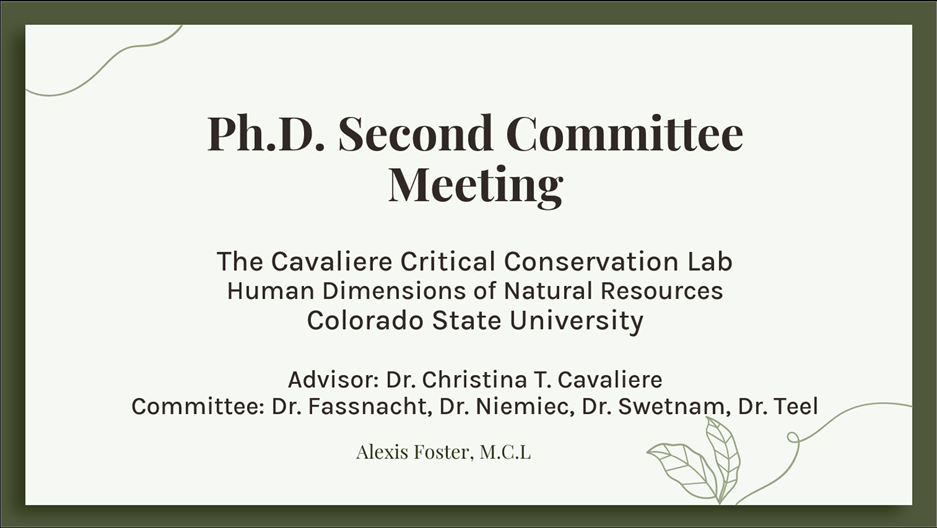
It is with great enthusiasm that The Cavaliere Critical Conservation Lab announces that Alexis R. Foster has advanced from PhD student to PhD candidate. On December 1, 2025, Alexis presented her dissertation topic of “Overtourism Challenges in Two Northern Colorado Recreational Areas: Understanding community perspectives and management approaches in Lory State Park and Horsetooth Reservoir.” This research takes place within the community of Larimer County, specifically Fort Collins and Bellevue, Colorado focused on overtourism perspectives and management approaches at these two locally significant protected areas.
In conjunction with the Lab, Alexis will be investigating overtourism communication strategies employed by management authorities, evaluate how overtourism is addressed within existing management strategies, and will assess park stakeholder concerns regarding overtourism impacts at the two parks. Email Alexis at Alexis.Foster@colostate.edu if you are interested in participating in an interview!
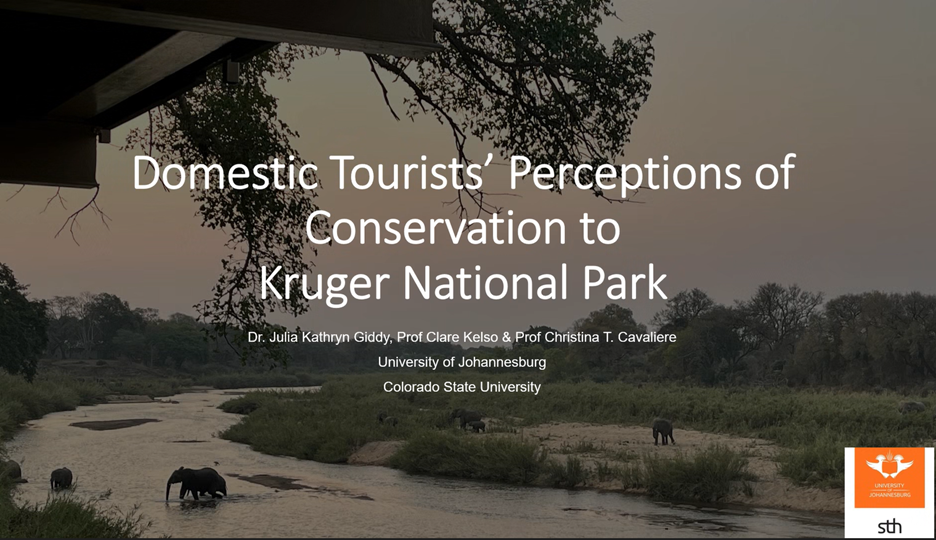
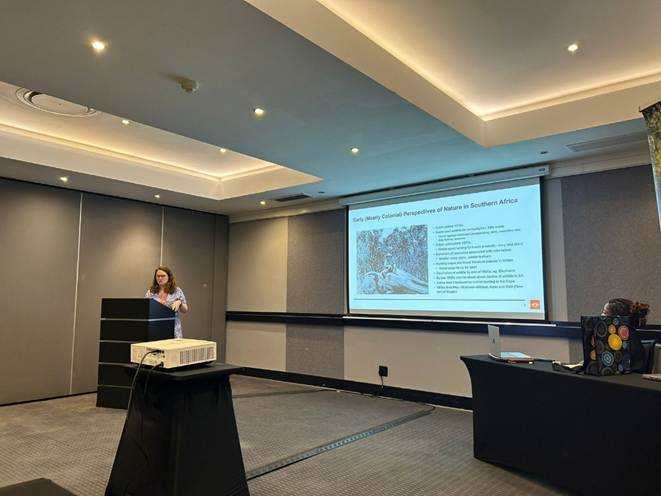
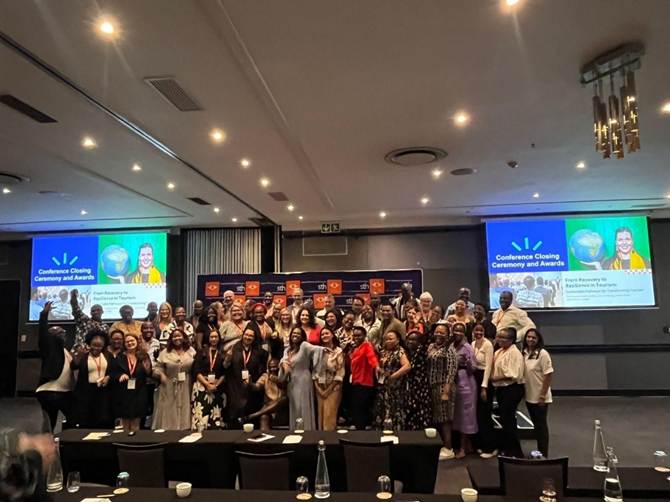
Dr. Julia Kathryn Giddy presented the co-authored work with Dr. Clare Kelso & Dr. Christina T. Cavaliere, titled “Domestic Tourists’ Perceptions of Conservation to Kruger National Park” at the From Recovery to Resilience in Tourism: Sustainable Pathways for Transforming Tourism conference. The conference was held from September 1-5, 2025, at the Maslow hotel Sandton in Johannesburg South Africa. The conference was co-organised by the School of Tourism and Hospitality, University of Johannesburg, and the University of Oulu in Finland. It focused on sustainable pathways for transforming the tourism industry, and its’ community and environmental relations in the context of recovery and resilience building.
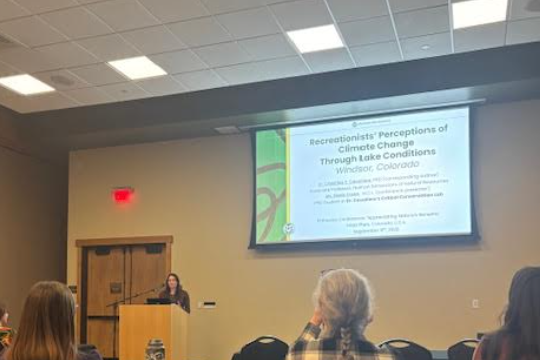
The Pathways 2025 Conference “Appreciating Nature’s Benefits” took place from 8 to 10 September to share research addressing the myriad of issues that arise as people and wildlife struggle to coexist in a sustainable and healthy manner. PhD student, Alexis Foster, presented co-authored work with Dr. Cavaliere at the session, “Citizen Science & Participatory Programs.”
Alexis’ presentation at Pathways was entitled Recreationists’ Perceptions of Climate Change Through Lake Conditions, Windsor, Colorado. The Lab is very proud of Alexis as this was her first academic conference presentation. In addition, Alexis contributed to the lab’s mission of communicating scientific information to the community and in support in Colorado State University’s land grant mission.
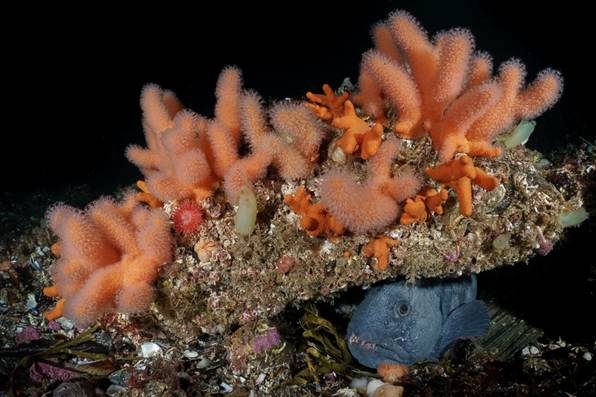
The international research team including Drs. Hoarau-Heemstra, Cavaliere, Nazzarova, Hoarau, & Kline from the United States and Norway, have published the article “Making the wolffish personal”: exploring the role of tourism wildlife equity and biocultural conservation” in the A-ranked Journal of Sustainable Tourism!
(Click the image below for open access to the publication)
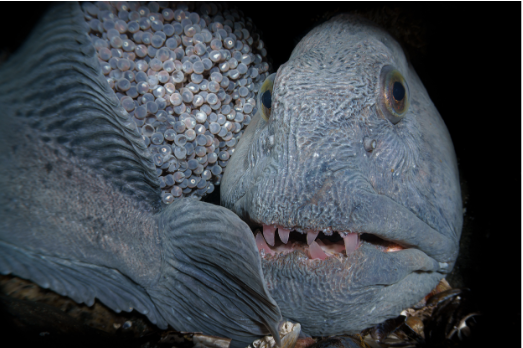
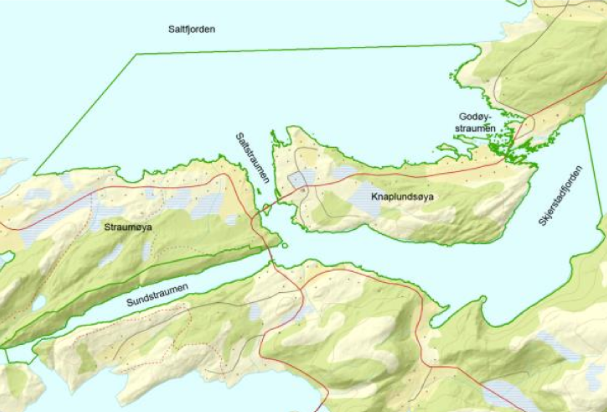
The new publication is significant for the Lab because Dr. Cavaliere’s previously co-authored posthumanistic theory (Wildlife Equity Theory) and conservation framework (a Critical Biocultural Identity Framework) informed this empirical fieldwork. The resulting Multispecies Tourism Communities outcome, demonstrates that conscious, complex relationships amongst humans and nonhuman stakeholders, protect this keystone species. Findings indicate that these interspecies relationships with the wolffish allow the wildlife to be recognized as sentient stakeholders that are more equitably conserved within the Marine Protected Area (MPA) of Saltstraumen.
Source: Galice Hoarau
Dr. Cavaliere and co-authors analyze the conservation status of the wolffish within Saltstraumen, as until the summer of 2024, it was legally allowed to hunt the wolffish with a speargun inside the MPA. The MPA is a popular Arctic tourist destination for diving and fishing and is one of the world’s strongest tidal currents.
The new Wildlife Equity Theory (Kline et al., 2023) guided the posthumanistic methodology for this research by positioning nonhuman species as active stakeholders within the system allowing for multispecies community cohesion to be incorporated. In addition, the Critical Biocultural Identity Framework (Cavaliere & Branstrator, 2023) guided the methods by providing indicators that framed the design of the qualitative inquiry.
This study allows insight into the human-wolffish relationship and demonstrates how influential the tourism system is to “decision-making processes, policy formulation, and multispecies community cohesion” (Hoarau-Heemstra et al., 2025, p.20). Wildlife agency is directly related to equity within the Anthropocene, and the paper demonstrates how multispecies perspectives are directly linked to justice and equitable biocultural conservation.
Congratulations to Dr. Cavaliere and her co-authors on this influential contribution to critical biocultural conservation research!
On April 25th, Alexis Foster proudly represented the Cavaliere Critical Conservation Lab on a field trip organized by Dr. Christina Cavaliere and Kathryn Metzeger [Program Manager, CSU Tourism & Conservation Graduate Programs]. Dr. Cavaliere represents CSU on the Colorado Tourism Office Destination Stewardship Council, where she interacts with Colorado tourism stakeholders to support sustainable tourism management in the state. In this instance, Visit Longmont serves as a wonderful destination management organization to provide experiential learning for our students in the Master of Tourism Management program. The students in Dr. Cavaliere’s NRRT 609 Tourism and Conservation course started the field trip by attending a guided tour at Jack’s Solar Garden, where they learned about agrovolterics and the connection to tourism. Next, the group enjoyed a lunch break at the Parkway Food Hall, bringing culinary tourism into the experience. Then, a conversation with Ryan Kazee from Angles Sport Ski Board and Fly Shop brought local tourism business perspectives to our learning goals for the day. Finally, a discussion with Sarah Leonard, the Chief Destination Stewardship Officer at Visit Longmont, was held with the students about how the DMO is approaching and implementing elements of the new Colorado Destination Stewardship Strategic Plan. A heartfelt thank you to Dr. Cavaliere, Kathryn, and all the dedicated community leaders for organizing such an impactful field trip. Overall, the students had a great time exploring sustainable tourism management in the field and were inspired by all the learning experiences and conversations. CSU would specifically like to thank Visit Longmont and Sarah Leonard for their kind support in sponsoring the student visit! Please see the video below for a recap of the student experiential learning in the field:
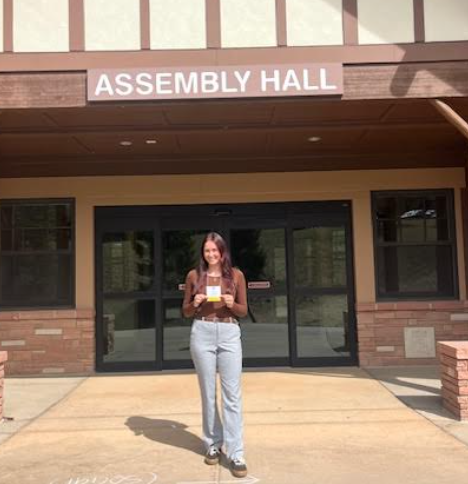
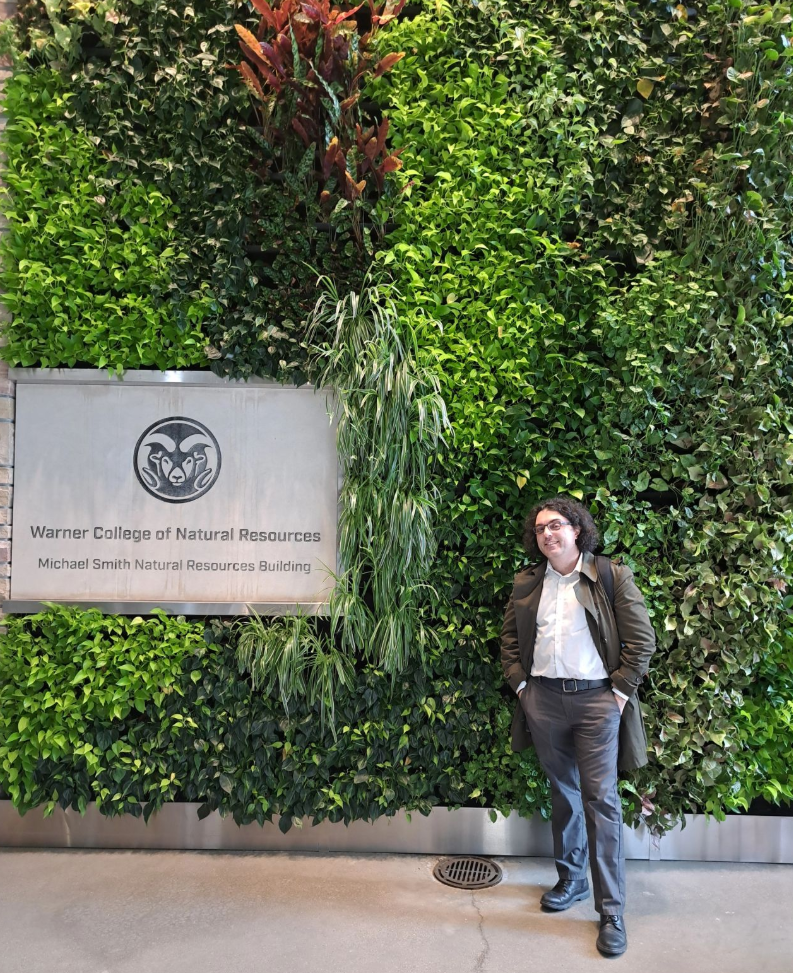
Dr. Christina T. Cavaliere’s commitment to academic mentorship and scholarly excellence has led to a wonderful achievement for her current PhD student, Alexis Foster, who has been awarded the prestigious Dr. Jean Bethke Elshtain Scholarship. As the director of the Cavaliere Critical Conservation Lab, housed in the Human Dimensions of Natural Resources Department in the Warner College of Natural Resources at Colorado State University, Dr. Cavaliere has cultivated an environment that nurtures rigorous research focused on conservation social science, sustainable tourism, critical thinking and social-ecological justice. Dr. Cavaliere’s nomination articulated Alexis’ contributions to these fields, demonstrating a strong alignment with the intellectual legacy of Dr. Jean Elshtain, whose work in social and political ethics continues to shape academic discourse.
Following a rigorous selection process, Alexis Foster was chosen as a recipient of this distinguished scholarship, recognizing her dedication to interdisciplinary research under Dr. Cavaliere’s tutelage. In the research lab, they extend Dr. Cavaliere’s intersectional research that integrates ecofeminist perspectives, justice, and sustainable tourism management. Alexis’ scholarship will empower her to continue her doctoral work focused on the impacts of overtourism within Colorado’s Lory State Park and Horsetooth Reservoir.
Congratulations to Dr. Cavaliere for her steadfast mentorship and support of her students and for fostering a research lab that exemplifies critical inquiry. Additionally, congratulations to Alexis Foster for this well-earned scholarly distinction. Their achievements reflect the pursuit of academic excellence and ethical engagement that define the mission of the Dr. Jean Bethke Elshtain Scholarship. Dr. Cav and Alexis extend their deep gratitude to all those involved with the scholarship selection committee!
The Cavaliere Critical Conservation Lab was honored to host Dr. Alberto Amore, a distinguished visiting scholar from the University of Oulu. Dr. Cavaliere invited Dr. Amore to present his research as it is deeply related to our lab’s research emphasis on biocultural conservation and tourism. Dr. Amore leads the Biodiverse Anthropocene Lab at the University of Oulu, focusing on tourism-related research in urban regeneration, planning, and resilience. His presentation is entitled “Resilience and regenerative turns in tourism,” and provides valuable insights into these interconnected areas of tourism studies. Dr. Cavaliere and the lab are excited to offer this research presentation free of charge to the public in partial fulfillment of CSU’s Land Grant mission.
Dr. Cavaliere is excited to share the official start of her most recent Ph.D. Student Alexis Foster. It is tremendous to welcome Alexis into the Cavaliere Critical Conservation Research Lab. Alexis has a background in Conservation Leadership as well as Ecosystem Science and Sustainability which will allow her to connect critical tourism impacts to biocultural conservation research. Alexis was awarded a scholarship through Dr. Cavaliere’s Critical Conservation Lab to support her upcoming Ph.D. journey with Dr. Cavaliere. Welcome Alexis!
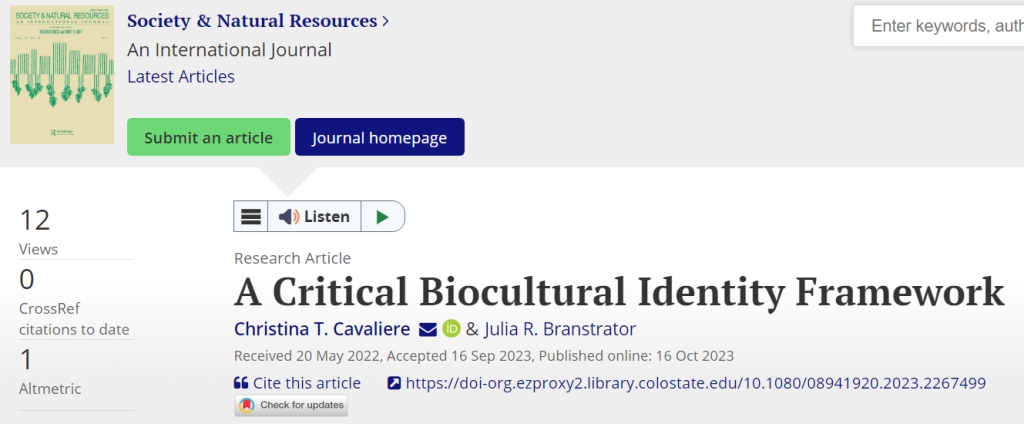
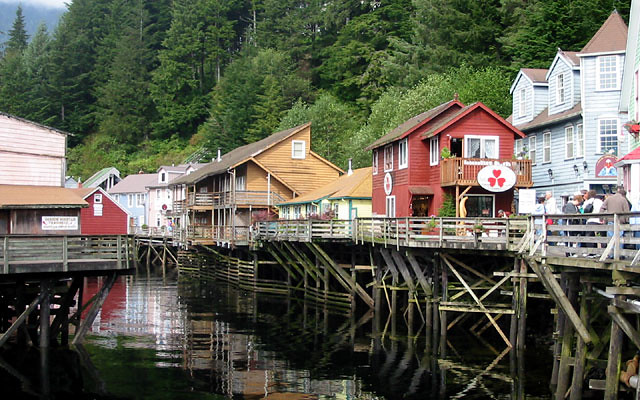
Leading this latest paper, Dr. Cavaliere with co-author Dr. Julia Branstrator, present A Critical Biocultural Identity Framework. This publication analyzes remote fieldwork during the quarantine lockdown period of COVID-19 in the coastal community of Ketchikan, Alaska (May – September 2021).
During this unique window of time of mobility restrictions, residents unpacked their relationships to the coast and encompassing bioregion of Ketchikan, revealing the impacts of overtourism and economic dependence on the multinational conglomerate mass cruise industry.
Presenting in-depth, qualitative semi-structured interviews, the Critical Biocultural Identity Framework expands place identity through critical ecofeminist-posthumanistic epistemologies to situate biocultural identities within the structural power components of Ketchikan. This research contributes thick empirical data to understandings of biocultural identities, which may be described as “the intertwining of social-ecological relationships and diverse knowledges that situate characteristics within bioregional constructs” (Cavaliere & Branstrator, 2023, p.9)
Thematic analysis of data resulted in nine empirical themes contributing to biocultural knowledge including: temporal engagement, emotional associations, interspecies interactions, local knowledge networks, bioregional relationships, ecological intimacies, neolocal resilience, nonverbal expressions, and sensory connections.
Each theme explores aspects of biocultural identities through social-ecological and bioregional contexts. The CBIF positions biocultural identity within social science conservation to resist biocultural homogenization of biodiverse places from neoliberal encroachment via mass cruise tourism.
As featured on the Warner College website at Colorado State University, Dr. Christina Cavaliere “is a global leader speaking out for equity / inclusion and impacting women’s roles and recognition for the better in our department and around the world… of note this year was her influence leading to greater representation by women as keynote speakers in the Tourism Naturally Conference [which had 1000+ registrants from over 50 countries] in October 2022.”
Dr. Cavaliere continues to center justice, wildlife and multispecies equity and gender within biocultural conservation and tourism. We are delighted to celebrate across multiple channels this exciting achievement!
Dr. Cavaliere explains the work of the research group:
“Wildlife Equity Theory is a new concept that we developed that builds upon previous works in biocultural conservation but also brings in concepts from gender studies, anthrozoology, geography, ecotourism and Indigenous perspectives on nature. This paper addresses the study from a transdisciplinary intersectional ecofeminist approach. It is imperative to mention that this research also contributes to a growing body of literature that connects diversity, equity, and inclusion (DEI) to conservation and sustainability. And while DEI or Justice, Equity, Diversity, and Inclusion (JEDI) initiatives are typically focused on equity and justice within human societies, our paper asks for us to consider the broader realm of animal stakeholders as keystone members for consideration. It is a conceptual analysis that draws on the theory and insights of tourism, sustainability, biocultural conservation, and animal ethics epistemologies. This research is also applied and outlines the ways in which the Sustainable Development Goals (SDGs) need to re-address the equity and inclusion of wildlife rights and protection through examples pertaining to each of the 17 SDGs where Wildlife Equity can be integrated and/or improved upon throughout the tourism system. This is essential for various aspects of system change intended to support human–wildlife relationships and biocultural conservation.” – Dr. Christina T. Cavaliere